

You can find the lectionary readings for this reflection here. I drew on both the gospel passage and the one from Acts.
Both of the stories we heard today explore some aspect of what the values and attitudes of the emerging Christian community of faith are, and how those values guide the way we organise ourselves.
That doesn’t sound very exciting, does it? But stay with me, I think it could well be the most exciting thing you hear all day!
So, let’s look first at how the leaders of the church in Jerusalem reacted to the news about Peter’s encounter with the Roman Cornelius and his family. If we hadn’t skipped parts of the story, this would now be the third time we hear of Peter’s dream with the sheet and all the animals in it and the voice that told him to break Jewish purity laws and how he protested but the voice insisted that there were no unclean foods. This is the vision that prepared him to receive the summons to the house of a Gentile, to go inside and preach the good news and then to baptise the entire household after seeing that the Holy Spirit was already present and active in them.
That’s not the part that got him into trouble, by the way.
The leaders of the church aren’t upset because he preached to and baptised Gentiles, but they are accusing him of eating with Gentiles. And when they are silenced by Peter’s question: who was I that I could hinder God? What they recognise is that ‘God has given even to the Gentiles the repentance that leads to life.’
The issue they are struggling with here, is the realisation of a loss of privilege. Up until now, the Jewish people had clear and firm boundaries about membership in this faith. This new development meant changes so big that it took several confrontations to work out how to accept that membership would be different from now on. That belonging would be different. That traditions like circumcision and ritual purification and keeping kosher – these were losing their significance – they had become meaningless in the new community of faith.
Over the centuries, any time human beings have organised themselves as a community, we create structures of power and rules of belonging. Our rules and structures have become more sophisticated over time, and we’ve even experimented with more open, power sharing approaches to organising ourselves. But most of our clubs, associations, institutions, corporations work with a top down power dynamic and an in/out approach to membership.
When I first became a Christian in the 80s I was told that the Roman Catholics weren’t really Christians and were probably not saved. At a Baptist church in the US which we visited once, my daughter told the Sunday School teacher that her dad worked at the university. After the service we asked her how she had liked Sunday school as she looked very worried. ‘Most of the people in the university are going to hell’, the teacher had told her.
I don’t know, but I think sometimes we seem to enjoy excluding people. Theologian and saint, Thomas Aquinas said something along the lines of “the bliss of the blessed in heaven is made the greater by viewing the torments of the damned in hell” . Ahem.
The only way I can understand this attitude is that perhaps it increases our sense of safety, gives us a sense of power and control. We can say who is in and who is out.
How sad that this is the same thing that was happening in Acts and we have still not really learned how to do things differently.
Because it’s not like we don’t have any idea what needs to change. Jesus couldn’t have said it much more clearly, and he said it often in a number of different ways.
In the passage we heard from John’s gospel account this morning, we start with the words ‘when he had gone out’ – just for context, this is Judas Iscariot who has just left the upper room. And now we all know where he was going, and so does Jesus.
So, in these precious last moments, first he tells the rest of the disciples ‘what is going to happen next reveals God’s glory, and that’s probably not going to look like what you expect.’
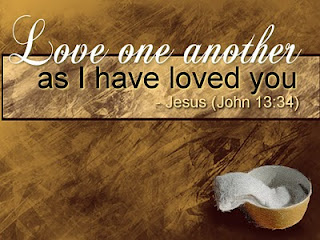
And then: ‘I don’t have long left with you, so it’s important that you grasp this: love one another as I have loved you. This above all else.
This: Love. One. Another.
Love is the command. Love is the guiding value. And that’s gorgeous and beautiful, except that we don’t really know or understand what it means in practice. I have been giving this a lot of thought for quite some time now. Because love is confusing, isn’t it? I read recently that some researchers surveyed a huge amount of people asking them to put different words into categories – words like hope, love, shame, anger. Are these words nouns, describing a feeling, or are they verbs – an action?
Most people categorised love as a noun. A feeling.
I used to think that too, and so I always found this passage difficult because how can Jesus command us to feel a feeling? If I don’t love someone, I can’t just decide to feel love for them. We all know you don’t choose to fall in love with someone, it just happens – and the same with falling out of love with them. And, like many children of my era, I was scarred by hearing my mother say that she loved me but she didn’t like me. What kind of useless love is that? No child can separate ‘who I am’ from ‘what I do’. Obviously, my mother had trouble with that too.
Anyway, if love is actually a verb, an action, a set of actions, a way of moving, meeting, receiving, sharing, respecting, asking, waiting – if these are the actions of love then we absolutely can choose to love.
We can decide to act with love toward someone – even one who says or does things we do not like.
We can move towards them with respect and compassion, we can choose not to be offended by them or judge them. We can choose to show concern for them. We can decide to listen without prejudice; we can acknowledge their story and perspective without agreeing with them.
I find this a very freeing and encouraging idea.
However, like me, you may also have received some unhelpful messaging about how lovable you are. Love your neighbour as yourself implies that we can see both neighbour and self as lovable and can move equally toward self and neighbour with compassion. For many of us there’s some confusion around the difference between self-love and selfishness.
Self love is when we are genuinely caring for ourselves. It is being willing to see our light and our dark, accepting what we are and what we are trying to become. Self-love is recognising our faults without shame and blame and taking responsibility for our growth. This kind of loving regard offered to our own selves actually gives us space for the grace to offer the same loving regard to others – who are equally a blend of light and dark.
By contrast, selfish people are usually grasping for a sense of self-worth and living in fear. They are oblivious to the needs of others, find no pleasure in the joy or growth of others, or in giving but only in receiving – because they live in scarcity. Being selfish isn’t about loving yourself, it’s believing that you are not worthy of love.
Adding to the confusion, you have also probably met people who seem very giving, very unselfish. Sometimes that is genuine, and sometimes it is a way to tie others to them – to make alliances or to collect favours and have others be indebted. And sometimes that generous unselfishness is simply the inability to say ‘no’ to any demand. If you do not value yourself enough to see that you have your own requirements for growth, then always doing what others want is not unselfishness at all. It is falling asleep to and abandoning your self.
Love one another, Jesus commanded us. Love one another as I have loved you.
Jesus’ whole life and teaching is summed up here.
Do you know how he has loved us? The low hanging fruit here is that he died on the cross, isn’t it? And of course, that’s true, and yet, it’s actually not very helpful to us as a daily practice. We don’t have many opportunities to lay down our lives for our friends, literally.
So, how else has Jesus shown us, taught us what love in action looks like?
I have a list:
- Daily/mundane acts of service (washing feet/doing laundry)
- Asking questions (who do people say I am? What do you want me to do for you?)
- Healing touch – kind hands, kind words, kind heart.
- Sharing food – eating with the tax collectors
- Inviting and accepting invitations – Zacchaeus, Simon the Pharisee
- Compassionate connecting – tears for Lazarus, telling the leper who believed Jesus could heal him if he chose to and Jesus reply:I do choose.
- Generosity – water into wine… so much! Feeding the crowds and leftovers
- Inclusion and Diversity- Jesus is embracing and affirming – the centurion’s faith, the Samaritan woman, the disciples – zealot and tax collector – women and men, children are valued.
- Space for grace – the rich young man turns away and Jesus lets him find his way to grace in his own time.
This is a great list of love as verb – love in action.
Now. What is one thing you will commit to doing this week as love in action? It can be an act of self love, can be love offered to another. It can be a small step, a little thing. Little can be big.
But pick something for this week and then tell someone so you can be accountable for your intention.
And then check in with each other. Ask, how’s that going for you? How hard was it, or how easy? What got in the way? These are great questions for us to ask each other as we practice these simple, small steps on the path to great love.
In your circle of family and friends, it’s how people will know that you are one of Jesus’ disciples, and in the bigger picture, it’s how we will learn to break the cycle of fear that leads congregations to focus only on preserving and protecting themselves.
Love in action is love for self and others and that means freedom for all – freedom from grasping for a sense of worth and fitting in so that you can belong.
And to end, Jesus shows us what love is and does, shows us God’s wide and wonderfully inclusive love. This is what it sounds like – these are the slightly edited opening words of welcome from the Evolving Faith conference in 2020:
To you who doubt, who struggle, you who feel lost – you are loved.
Athiests, agnostics, seekers – you are loved.
You who are disabled, you who carry chronic pain, you whose bodies challenge you in ways you are tired of explaining – you are loved.
Shy people and introverts, you raging introverts, you raging extroverts– you are loved.
You who do sex work to pay the bills and you who are clutching your internal pearls because I just said sex work – you are loved.
You Pentecostals and Catholics, latter-day saints, all manner of frozen chosen, Baptists, anabaptists, church surfers and the denominationally promiscuous – you are loved.
You white people, and you who are blessed with extra melanin – you are loved.
Conservatives, liberals, moderates, those who detest these classifications– you are loved.
Straight, gay, bi, trans, non-binary, a-sexual, pansexual– you are loved.
You who maintain a façade of perfection even as you fall apart on the inside, you who are flagrantly messy,
you who bring incalculable grief with you,
you who are irrepressibly, annoyingly joyful – you are loved.
All who are simultaneously sinner and saint, all you children of God all you are cherished siblings– you are loved.
You all are loved.
God loves you.
Did I miss anyone out? God loves you.
This is love. Feel it. Know it. Hold it. All of this is there for you.
Now, go and do your one small thing

