


This sermon was preached on February 25th, and included some time for conversation – the prompt is at the end of the reflection. The texts we heard were: Isa 55:1-11; Ps 119:105; Jn 1:1-5
Today we’re starting a four week series which is part of a six month series exploring six streams or traditions in the history of Christian faith.
The six streams were given names by a group founded by spiritual leader Richard Foster – Evangelical, Holiness, Social Justice, Charismatic, Contemplative and Incarnational. Each stream was identified from the fruit of various movements through history, and from the focus associated by those in that movement. It’s ok if none of that means anything much to you, because we’ll be dipping our toes in each stream and I’m hoping that you’ll find there’s some familiar and some new things in each one as we go.
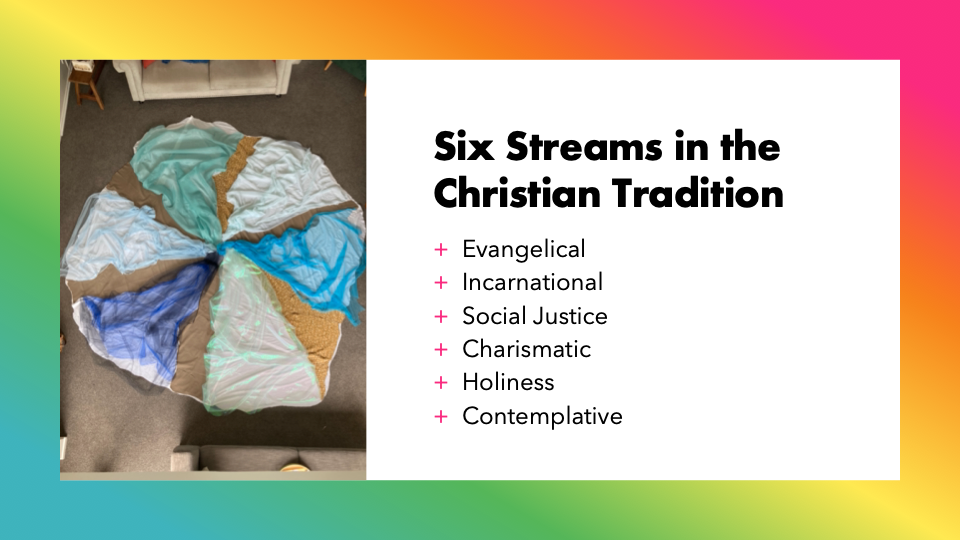
We are going to begin with the Evangelical stream. The Evangelical stream reflects an aspect of Christian faith practices that are word centred. They are word centred around the three ways that we encounter the story of God’s presence and action in the world – Jesus the Christ who is the living word, the Hebrew scriptures and the New Testament as the written word, and the stories of faithful followers of Christ as the spoken words.
“Evangelical” is a term which has some baggage, and so today we’ll explore what the stream is really about, and talk a bit about what this word means to each of us.
Firstly, let’s just unpack that word a bit.
In Greek, euangelion means good news. Angelion means messenger, bringer of news (angels), and eu means good – like euthanasia, euphoria. In Christian history, however, evangelical has become associated with a particular approach to Biblical interpretation, which includes a particular view of God, humans, the world, heaven and hell.
It would be more accurate to call this evangelicalism. The history of evangelicalism is fascinating – we can talk about that more later if you’re interested.
The important thing for us to notice this week is that there are three ways we encounter the story here. We heard just now those very familiar opening lines from John’s gospel. In the beginning was the word. I’m going to be nerdy here and talk about Greek for a moment, but please don’t switch off – this is important. Our bible is translated, and translation is a tricky art. The word used in Greek for the word in John’s opening sentences is LOGOS.
This word does not mean word – not in the sense of letters strung together to make words in a sentence. The Greek word for that kind of word is lexis.
LOGOS means something more like ground, speech and expectation. In the beginning was the ground of all being, in the beginning was the breath of God, in the beginning was hopeful presence of the holy in and through all things. John is equating Jesus with this ground of being, breath of God and infused holiness. Not with the bible. Not with the Hebrew scriptures or the writings of the New Testament. It’s important for us, because as part of the reformed tradition, we tend to add an extra element to the Trinity – Father, Son, Holy Spirit and Holy Bible.
Or we tend to think Jesus and the Spirit is present to us in the Bible, rather than, or more than, in any other way. So the word centred life is not a life centred around the bible any more or any less than the other streams. All of the streams hold scripture as a foundational , guiding element. But Christ is the centre of the focus.
You might be puzzling over that – which is great!
The evangelical stream invites us to pay attention to the three ways that we encounter the story of God’s presence and action in the world:
- Jesus the Christ who is the living word,
- the Hebrew scriptures and the New Testament as the written word,
- and the stories of faithful followers of Christ as the spoken words.
And it put special emphasis on the spoken word – the ways that we tell the story, bring the good news of God’s action and presence in the world.
You may be feeling pretty uncomfortable about that – which is fine, too. Honestly, I’m with you there. Talking about God can be awkward. So, let’s dive in to some conversation time.
AND