

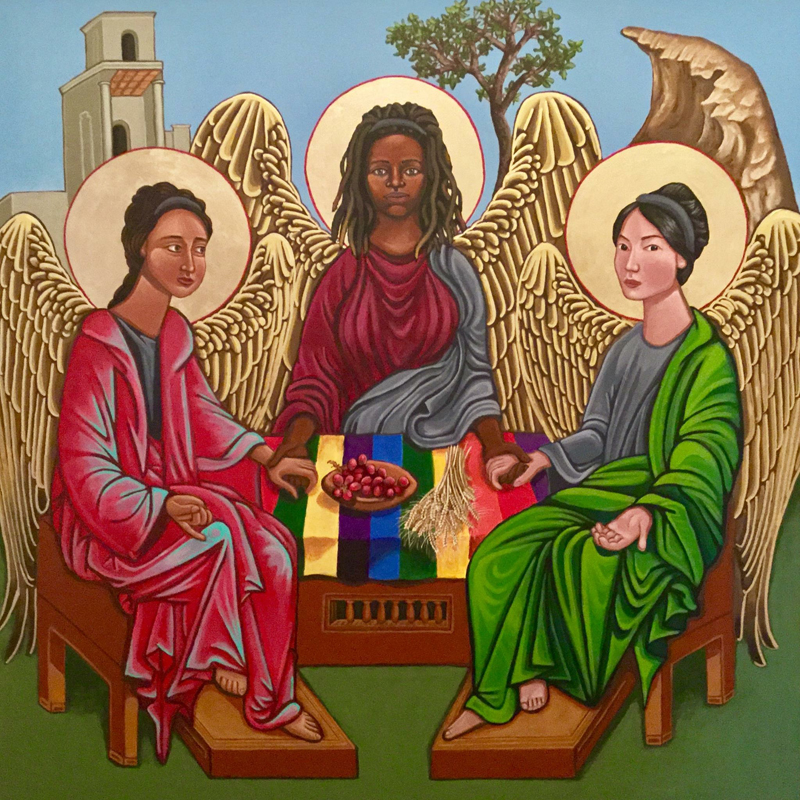
You can find the readings for this week here.
I think it is a beautiful coincidence that we have this reading on mother’s day – since Easter is a moveable feast, this doesn’t always happen.
And although mother’s day originally began as a celebration of Mary’s yes to the angel and the subsequent conception of the Christ child – so a celebration of Mary as the mother of God – we reformers have done away with all that and made it about mothering in a more general sense.
Last week we heard the story of Saul’s encounter with Jesus on the road to Damascus. We are so easily drawn to the dramatic aspect of that story, that the part Ananias plays is usually diminished. In my reflection I drew our attention to Ananias and how he is, in fact, the pivotal part in progressing Saul’s transformation. This week, although we are still in chapter nine of Acts, we have moved on from what Paul is doing to see what Peter is up to. I wonder if asked you who this story is about, what would you say?
Because obviously, this is a story about Tabitha.
If I had asked you before the reading if you knew anything about Tabitha’s story, though, I wonder what you would have said? The chances are you may not even have heard of her, and if you did remember hearing this story, you probably would have struggled to fill in many of the details about her. There are reasons for that.
Some years ago, when I was in a different church and in the process of applying to train for ordained ministry, I was invited to be on a Q&A panel for our youth group. The minister was asked too, and a lovely young man who was also one of the youth group leaders.
The youth were all invited to write their questions down and put them into a box and then there was some sorting into categories and checking for double ups before the evening. The questions ranged from sexuality to other faiths, from biblical authority to sin. Mostly, the three of us took turns to give our response and the others added or commented on what had been said.
One of the questions we were asked was something like: why is it there are so few women’s stories in the bible?
The minister jumped in and responded first by saying that this wasn’t true, and there were lots of women in the bible. He went on to say that feminism was divisive and that he preferred to think of himself as a humanist. The young man agreed with him and added something which I can’t remember because all I could hear was the blood pounding in my ears as I found myself silenced.
What could I say?
Up until that time I had felt great respect and affection for the minister, and I didn’t want to risk the relationship by publicly contradicting him – and I doubted myself enough to wonder if this were indeed the place to air such a confronting difference of opinion. So I said nothing. And I have deeply regretted that.
Because it may be true that women are mentioned in the bible, but there are very few stories that are women’s stories. And when they are included, we tend discount them and forget about them and focus instead on the men – which is what the biblical writers expected we would do.
So let me say it now: Women’s lives, women’s stories, women’s experience and perspective – our voices – are poorly represented in the biblical text.
For a centuries this has been normalised.
Moses, David, Gideon, Jacob, Joseph, Daniel, Matthew, Mark, Luke, John, Peter, Paul, James…these are the ones whose faith we were taught to admire and invited to learn from. These are the models of discipleship we are offered, and if you are comfortable with that, it’s either because you are male or you have learned to accept that these models are good enough for men so they are good enough for you.
We can talk about man and mankind because as far as everyone was concerned, the word man implicitly includes women. But it’s not true.
The word man means men, in the same way that the word woman means women.
Man does not breastfeed his baby.
Man does not conceive life and carry it or bring life to birth.
Man does not know what it is like to bleed every month or to fail to bleed.
Man doesn’t experience hot flushes and Man has no idea what those experiences are like.
And if you are feeling uncomfortable right now, it is most likely because it is our embodiment where those differences cannot be denied. We experience life in a body, as a body, through our body. And women’s bodies have been shamed, blamed and judged for centuries.
But the good news is that the ministry of Jesus Christ is one which breaks down barriers, crosses boundaries to raise up the marginalised and oppressed – and for those who are in the centre, who are in the position of privilege and dominance this feels like loss and threat rather than the inclusive expansion that grows out of love.
It is not only men who are threatened by this kind of talk. Often women are the strongest resisters to their own equality because for centuries we have been told that we are less – and we have not only accepted that limitation, we have also taught it to our daughters.
That is a special kind of betrayal – the same kind I felt guilty of when I didn’t speak up in front of a group of young women and instead allowed the message to be reinforced for them.
And it’s hard to allow that to be true so instead, we dismiss our sisters who speak the truth of their experience and perceptions. We shame them and criticise them and try to silence them. But when we do this, we are simply agreeing with the values of Caesar and the empire he built. Because these are not kingdom of God values.
Jesus had many interactions with women. In John’s account of the gospel, the woman at the well is the only person Jesus reveals his divine identity to, and Mary is not only the constant companion at the cross and the first witness to the resurrection she is also the apostle to the apostles. We don’t tend to make much of that though, do we?
Jesus healed and raised from the dead women and girls – members of the society who were not valued. In the same way he broke down the boundaries between Jew and Samaritan, Jew and Gentile, he reached out to lepers and the unclean, to the despised and to children, who were also not counted as of any societal value.
I’m pretty sure Jesus was a feminist because he was all about equality, and when he says in our gospel reading today “I and the Father are one”, the word he uses is neuter. We are one without gender. God the father is not male, but it’s almost impossible to imagine this, in the same way that its’ impossible to image a man breastfeeding a baby.
The title of Father God is not about maleness or traits that we have labelled masculine. Because it is so hard to disconnect the idea of Father God from our personal experience of fathers, however you experienced being fathered – whatever your dad was like, good and bad – these are the qualities you will assign to Father God.
That alone is a confronting idea for many of us, so you may find that you are feeling very resistant to all of this, or want to justify your image of God, or rationalise or propose a counter argument. It’s ok. I’ve been there.
But for some, this is perhaps the most comforting thing you have ever heard.
These are the qualities of God’s parenthood: compassion, wisdom, joy, gentleness, constancy, tenderness, trusting and trustworthiness and above all and through all, fully present.
God as parent: holds, comforts and guides us, gives us space to stretch and to fail and at the same time supports and encourages; calls us to be accountable and to take responsibility for ourselves and our actions; shows us truth even when truth is painful because it is shown in a way that we can receive and take to heart, learn and grow from. I’m confident none of us had a father or a mother like that – or not all the time.
And for many of us, we can see that there are qualities in there that our culture denies to men and judges them for. And there are qualities that our culture encourages in and expects from women.
So if your image of God has, until now, been exclusively male and masculine here’s an invitation for the coming week: Let God be mother to you. Let some of those culturally feminine qualities shine through the divine image of Holy Wisdom, of our mother God – because God wants to be known and is never pushy or imposing.
Give it a try. Replace Father God with Mama God and just see….just see if it makes a difference, if it opens something new for you or draws you deeper in.
And finally, let me refocus our attention on the story of Tabitha and let’s once more discover some things about the unsung, ordinary disciple who this time shows us what embodied compassion looks like from a woman’s perspective.
Tabitha is named as a disciple. She is a significant person in this community, and we can tell that because the clues are there in the text . We have her name in both Hebrew and Greek, indicating to us that she was probably well educated (also unusual) and bilingual, ministering as a bridge between Judaism and the Greek world. We know she is devoted to a ministry to widows, a group that were particularly vulnerable, and it’s a ministry that has developed strong and deep relational bonds. Clearly, she is well loved and well regarded by all.
When Tabitha becomes ill and dies her loss is deeply felt by the whole community. Her special group, the widows, gather with garments that Tabitha had made for them. This makes me wonder – did she work with these widows to make the clothes, giving them skills, purpose, support group, meaningful work and dignity? Certainly, if she had simply been in the habit of giving widows a generous gift, that by itself doesn’t seem enough to prompt the outpouring of grief that we see here.
And it’s not just the women who are distressed by her death. When the community of believers hear that Peter is in a town nearby, they send two men to fetch him.
They send two men to fetch Peter for a woman. Wow.
The miracle that Peter prays for here is an intentional echo of Jesus’ ministry, one of many echoes throughout the book of Acts, all of which are designed to get across one message:
The ministry of Jesus Christ is now being embodied in the body of Christ, the faithful disciples – in short, us.
Tabitha was a resourceful, caring, generous, creative, compassionate and faithful woman. She didn’t have a mega church, she didn’t write best sellers, she wasn’t famous in her own time and we still don’t hold her up as a model of faith. But how many unsung, uncelebrated, unfamous women do you know who are quietly going about offering their ordinary gifts in service to love? How many have there been through the centuries – women whose stories might inspire all of us to start asking this simple question: in the body-of-Christ-embodied ministry of Jesus, what is mine to do?
And then start doing it fully, sincerely and with great love.

