

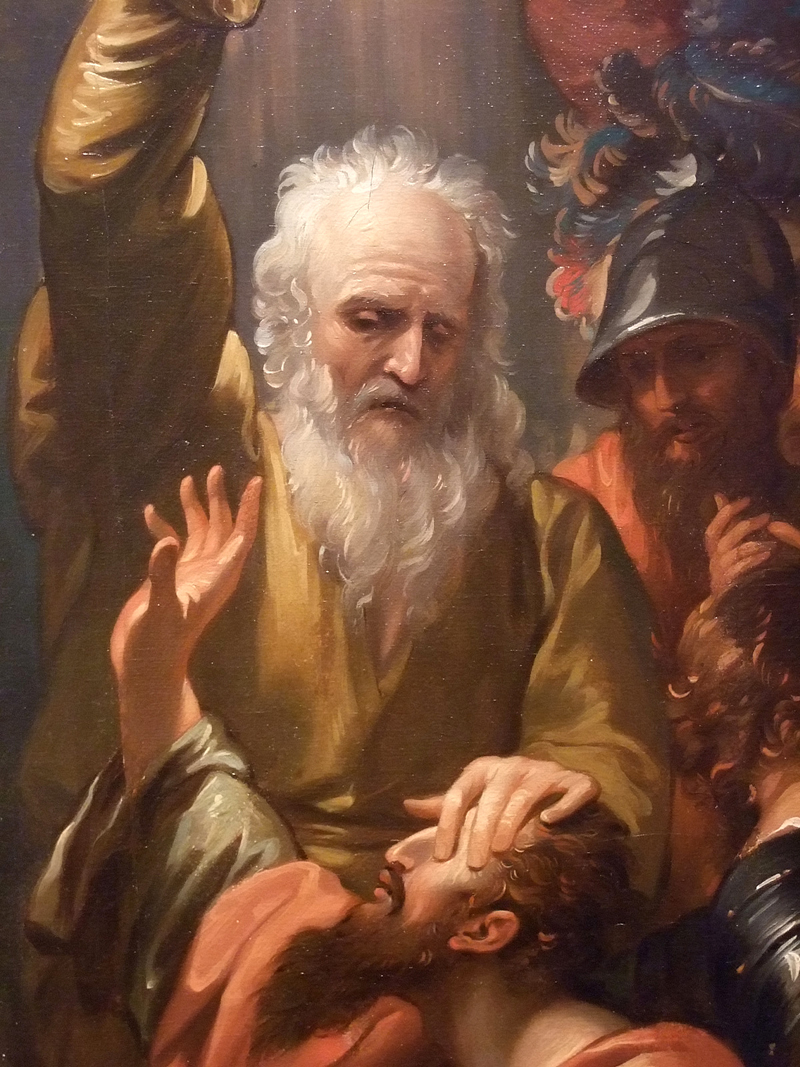
The readings for Sunday May 1st can be found here, and the following sermon focuses on the passage from Acts.
This story is usually known as the Damascus road conversion. It’s not quite true, though. Conversion is about a change of belief system- say from Muslim to Christian, from atheist to Buddhism and so on.
Saul already believes in the God who meets him on the road to Damascus. What he actually experiences is a revelation, a moment of epiphany with the God he already knows – but this moment reveals a truth about the familiar God which was, until now, utterly unknown. So Saul is not truly converted – he sees the light of the risen Christ and is blinded by it. And then he spends three days in the dark, without nourishment…almost like three days in the tomb.
This experience may well be what inspires Paul, when writing to the churches he has planted, to say that we have died with Christ and been buried with him. Perhaps, this is what helps him to identify so deeply with Christ in his death and in his risen life. Perhaps also, this is what fills him with joy and directs the passion which was so focussed on destruction prior to his encounter with Christ.
Either way, although the focus of this story is almost always on Saul, it’s only when Ananias, as a representative of the Christian community turns up in obedience and receives Saul into the community through healing and baptism, that Saul is able to return to life.
We often discount the part that Ananias plays in this story, but I suspect that there is a lot more for us in his part of the story than in the part about Saul.
Ananias is worth our attention because he’s probably more like us than Saul is. I identify less with the impassioned debater and unflagging evangelist than I do with the faithful believer who is called to embody and share the love, forgiveness and healing of God that I have received from God.
And, just before we focus on Ananias for a bit, a word of caution: don’t be too put off by the immediacy of Saul’s change of heart and his nearly instant move to preach. Acts is a very action-oriented book where everything happens immediately – after three days of inaction, Saul eats, is baptised and starts preaching about Jesus. This is the character of the book and the writing style not a reflection of what all life in the Spirit is supposed to be like.
So let’s consider Ananias. Essentially God instructs him to visit a religious extremist who has done great evil to the Christians in Jerusalem and who has been granted the authority to bring Ananias in chains to Jerusalem for trial.
More than that, Ananias is asked by God to offer this man who has done great evil – and who some might right off as entirely evil – forgiveness and healing. He is asked to offer the very same forgiveness and healing that Christians in Damascus have been preaching and practicing and being persecuted for.
In the most confronting way imaginable, Ananias is asked to walk the walk of faith.
As he does that, he shows us very clearly what Christian living and witness looks like. Ananias embodies compassion and courage even though he has a fairly resistant conversation with God before he agrees to visit Saul.
So, I have two things for you to consider.
Firstly, do you have those conversations? Do you push a bit and question a bit when you sense God’s prompting to move in a particular direction? Because I think that’s a very important aspect of following Jesus. Here’s why.
Sometimes, the voice of God seems really clear. Sometimes it’s not.
Ananias received a visionary visit from God – and even then he offered a challenge – are you sure? Do you know what you’re asking and what kind of man he is, what kind of danger I’ll be in?
I have never personally experienced a visionary visit. I don’t think they happen very often or to many people – I think most of us have much more trouble tuning in to God’s voice and identifying the prompts and nudges of the Spirit. For a long time, I thought that discerning the ‘right thing’ was a combination of a feeling of rightness and reading the signs as events aligned, as doors opened and as the path was smoothed out.
The trouble with that is that the feeling of rightness is self-referencing. I am not going to feel right about something I don’t want or don’t like or don’t agree with – not without some extra pressure being applied. I can’t trust a feeling of rightness without examining it very closely for self interest and even then I have to allow for my own hidden agenda, my blindspots – what I do not want to admit to myself or about myself.
And the trouble with expecting that God will make the path smooth – or not – is that it makes God into a stage director, acting behind the scenes to coordinate the movement of lights and action. And I have come to see that God is not a micromanager. Certainly, God is in the details, but that does not mean God is controlling the details.
Love does not reach for control – love gives freedom.
Often in Christian circles we’ll talk about God having a plan for our lives and I used to think that means there is a kind of heavenly blueprint we are trying to follow – the job we are supposed to do, the life partner we are supposed to meet and marry, the church we are supposed to belong to….
Despite being given very few distinct directions about it, we are supposed to fulfil this quite detailed and particular plan. I used to believe that completely and not without some anxiety.
But no more.
Obviously God does have a plan for life – for your life and mine. But that plan is that we will grow and flourish, and there are many, many different ways we can do that. If that is God’s plan for us, then it makes sense that sometimes the path to flourishing takes a meander through darkness and even depression – but that is still the path and God is still working for shalom through each stage.
I have come to believe, and to know that there is nothing God cannot use to bring about growth. Saul/Paul’s story is just one example of how God can take what is destructive and hurtful and turn it around. Peter, too, has a story of failure and restoration – I’m sure if you look at your own life and those around you there will be stories of good coming out of pain and of attitudes changed by love.
There really is nothing outside of God’s capacity to transform.
No matter what path we take, our God is moving and acting for love, for flourishing and healing as best as can be without compromising the freedom of our choices.
And the second thing to consider is this:
How might you embody love, forgiveness and healing to those who seem to be against you? We are not in the stark position of having our lives threatened for our faith, but still, I’m confident we’ve all had some experience of confrontation, of feeling attacked and maybe even persecuted.
What if you were free to forgive, to love, to heal that person?
Because this story assures us that we are indeed free to do just that – and this is what it means to follow Jesus. This kind of compassion and action does not come naturally to us. We have to work at it. We have to choose it – because we have that freedom not to choose love, not to act with compassion.
Just imagine how your life might be transformed by the conscious choice to show love even when you have been hurt or are afraid of rejection. Who knows what forces for change, for life and flourishing might be set in motion by your courageous act of compassion?
And if you are wondering what that might look like in your life…. Maybe it’s really listening to someone with complete openness; maybe it’s asking some questions to show that you are interested in them; maybe it’s finding a good quality in someone you have trouble liking and then letting them know that you appreciate that quality in them.
The old saying that charity begins at home is especially pertinent here. You cannot truly give what you have not allowed yourself to receive…so begin with your own self and listen to how you talk to yourself, listen to the things you say and ask some open and curious questions about that – is this the way I would talk to a friend? I wonder why I think this…react that way…? And look within your own self for the goodness you can affirm – a quality you have that isn’t what you do, but who you are.
This isn’t rocket science, but oh, my, it is hard.
We have to make it a practice, though, otherwise our following Jesus is less like being on a journey and more like a nice sit down on a comfortable couch.
You may not have been blinded by the light of the risen Christ, or visited by God in a vision, but you are called to follow nonetheless…
So some homework for you this week:
Ask with interest. Listen with openness. Appreciate and affirm the good.
I know you will have the opportunity to practice at least one of these things over the next week, and little by little, this is how we participate in the prayer of Jesus- that God’s kingdom will come here on earth as it is in heaven.

