

This story is told in all four of the gospel accounts. It’s not always told in the same way, with the same woman or the same objections, and it sits in different places relative to Jesus’ ministry and his journey to Jerusalem and the cross. But it is not often that we have a story all four gospel writers recount, so that tells us that this act of anointing was a well told, well known story.
And the differences in the ways that this story is told reveal it to hold layers of meaning and significance for those who were seeking to make Jesus and the gospel of love and reconciliation known.
John’s account of the gospel is notably different from the other three in many ways and his is often described as the most mystical gospel telling. Mark starts straight in with action – John the Baptist in the wilderness and Jesus steps up to receive his baptism. Luke begins with Mary and angels and Matthew begins with a long list of forebears. John begins with the beginning before the beginning. He begins with Eternity and the Ever Living Word and Light and Darkness.
So as we hear this story today of the anointing of Jesus’ feet at Bethany by Mary the sister of Martha and Lazarus we need also to place it in its particular John’s account context, because this gives the story more layers of significance and meaning.
It is a story about the beautiful exchange of giving and receiving; it’s a story about the understanding between two people that is beyond words; it’s a story about gratitude, grief, compassion, connection, courage, generosity…and it’s also a story which simply embraces mystery.
So, here we are six days before the Passover, and Jesus has recently performed a miracle. He raised Lazarus from the dead. Let’s just pause for a moment and let that sink in. A dead man, a man loved by Jesus and by his two sisters, a man who was dead for three days, was called back to life by Jesus. Has that sunk in a bit??
There are some important relationship developments that thread through and connect the story of Lazarus and our anointing story.
Jesus arrived too late to save Lazarus – it seems he deliberately delayed on the way – and so the sisters Martha and Mary experience both the anguish of watching their brother die, and of knowing that Jesus did not save him. How awful to be powerless and to know that someone else could have, but didn’t, do what you were unable to. The grief of loss is always made greater when we add the mental torture of what might have been, of what needn’t have been…
So the two women are weeping for their brother, but when they hear that Jesus is approaching the town, first Martha and then Mary go out to meet him. They both have conversations with him that reveal a depth and steadiness of faith and understanding that we simply do not see in the men who are named as Jesus’ disciples – not this side of Easter at any rate.
Martha expresses her absolute belief in Jesus as the Christ, as the light and life of the world. Mary expresses her utter faith that Jesus could have healed her brother and saved him from death if he had only arrived in time. This kind of trust and faith is not easily won or easily given. What a gift to Jesus, six days out from the Passover. Six days out from betrayal, abandonment and a tortuous death.
In response to their trust, and to their grief, Jesus’ own heart cracks open for these two women. And he gives them a precious gift in return. He trusts them with his tears. Their love and devotion make a safe space for him to weep and to let his own heart break open for them and with them.
Then he turns to the tomb and calls Lazarus to come forth, despite the concerns about the bad smell. Lazarus is restored to life.
After this, Jesus has to leave Bethany, because the chief priests had become highly alarmed by this miracle and the consequences likely to flow from it. This is the point where they begin plotting to kill both Jesus and Lazarus. So it is some days later and still at some risk, Jesus returns to his friends’ house for a celebratory feast.
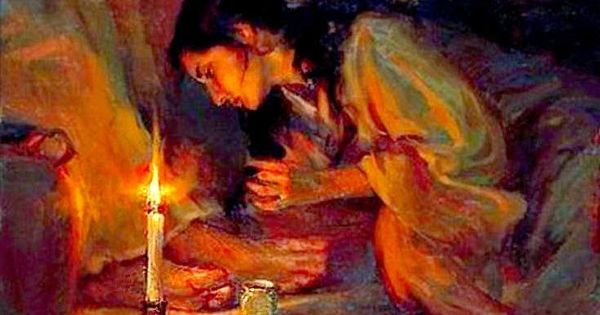
Martha serves, Lazarus reclines at the table and Mary takes her wildly expensive perfume and pours it out over Jesus’ feet. She uses her hair – her head uncovered – to mop up the excess.
The whole house fills with the beautiful scent.
Judas objects and even without John’s explanation of Judas’ thievery, we are predisposed to see his objection in a poor light. But to be fair, I think he objects in the way that many of us might, for all that John assigns a meanness and self interest to his words. How many of us, good Presbyterians, wouldn’t object to waste? I hate throwing out things that are perfectly usable, although if I think they are ugly I’d like someone else to take them so I can have something I like better…
But I don’t like waste. I keep the last nubbin of soap and squish it onto the new bar. And I do like to wear things out – slippers, jeans and jumpers as well as cars, couches and carpets. How many of us would be perfectly happy to ‘waste’ a year’s worth of minimum wage to fund a piece of art or a play or a lavish dinner?
Many of us are uncomfortable with extravagance.
Many of us were raised with a sense of scarcity or lack – not enough or just enough…and this isn’t just about being warm, dry and well fed. It can be a sense of not quite enough love, not quite enough safety, not quite enough understanding…
When we have that inner belief that there is not enough, it is very hard to experience the world as abundant, and so waste makes us understandably anxious. So let’s cut Judas a bit of slack here. He questions the use of resources – couldn’t we have done better than this?
And Jesus’ response reveals that Mary has a level of understanding and a level of connection with him that Judas has obviously missed. There is something happening here between them that is beyond words – that is mystery.
Mary knows something the disciples have not grasped and will not grasp for some time. With her costly perfume, she lavishly anoints Jesus in an act with two meanings.
Kings were anointed with perfumed oil, and next week is Palm Sunday when we remember and celebrate the so called triumphal entry into Jerusalem – the king riding into the city as the crowds cheered for him. But the dead are also anointed with perfumed oil as a preparation for burial. The king who rides into the city, rides on a donkey not a battle charger. The king who rides into the city will be dead in less than a week.
Mary knows something about who Jesus is, and what kind of Messiah he is. Not a conquering king, but a suffering one.
And in her act of beauty and extravagance she is telling Jesus: I know.
In Jesus’ acceptance of her lavish gift, and in his defence of her act, he is telling her: I know that you know, and I receive this gift from you. Mary’s gift is gratitude and abundance and grief and love.
In this last week before we begin Holy Week, in this final week of Lent Mary’s act invites us to consider our own responses of gratitude and abundance, our own expressions of grief and love.
So I have two questions for you to journey with this week.
How might you practice your faith in prayer – What extravagance can you express toward God by gratefully acknowledging God’s presence with you? Is it time? Tears? Tenderness? Some kind of offering of Beauty?
How might you practice your faith in action – Imagine how comforting it was to Jesus that Mary knew what his other friends did not – that he was soon to suffer and die.
In this time, when so many people, the Christ in others, need comfort – what can you do to bring comfort to the suffering, even if you can’t be physically present? How can you let them know that you know they are suffering?
And when the answers come to you…make your offering, even if it may not be understood by those around you. Make your offering even if there is a sensible voice within telling you that it is wasteful. Make your offering, for this is beauty, and the world can’t have too much of it.

