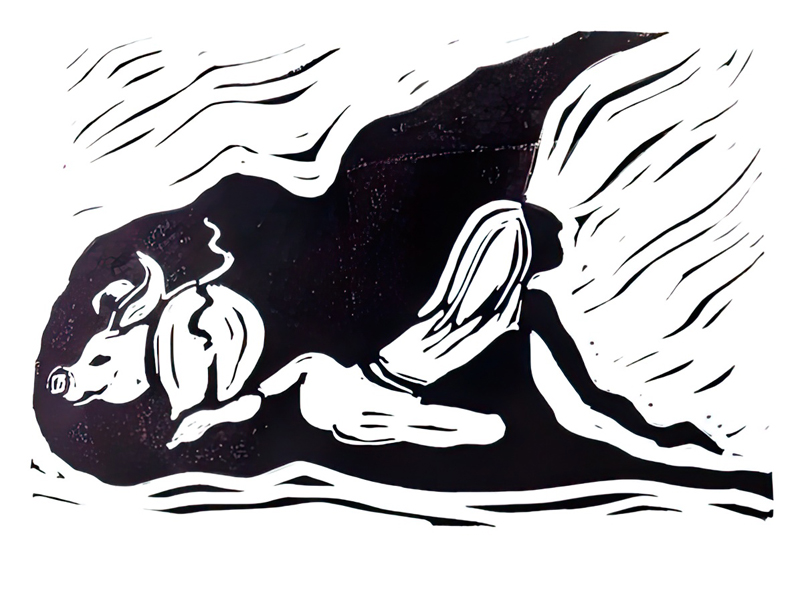

I have no doubt that this parable is well known to you, along with its companion parables of the lost coin and the lost sheep. The characters in this parable, like the one last week, are open to our interpretation and invite our empathic engagement.
When I’ve reflected on this parable in the past, I’ve mostly explored the ways in which I identify with the two siblings here. Sometimes I saw myself more in the rebellious, wilful one, striking out for independence and adventure, resisting the traditional expectations and obligations that seem to be intended to hold, keep and control the joy out of life.
And at times I’ve been able to explore the ways in which I identify with the overly responsible, quietly resentful, careful, respectful, cautious and dutiful one. The one who expects that eventually there will be recognition of uncomplaining hard work and there will be rewards.
As my children got older, I was also given the opportunity to explore the ways in which I identified with the patient parent who allows her children to take their destiny in their own hands; who gives enough space and freedom for them to experience failure, hurt and uncertainty – and to learn from it. Or not.
I’ve seen myself in all three of these characters and that’s one of the things that I think the parable is meant to offer – insight, understanding and therefore compassion for each of these differing experiences.
But this year, as I have sat with this teaching story, there’s a different aspect that stands out for me. Because this year, I noticed that the theme from last week’s reading also threads through this parable – the expectation of punishment for wrongdoing, the blessings for those who do what is right.
For a long time, probably since I first heard this parable, I understood it as a story of repentance and forgiveness. I’ve thought that because I was taught that repentance and forgiveness is at the heart of the cross. And when I read the parable with that in mind, I only saw how the younger son commits a catalogue of sins and what happens when he is properly sorry for them.
So the boy begins with valuing his monetary inheritance more highly than the life of his father, Which leads him through a period of ‘dissolute living’, which is obviously a description that carries some significant criticism and judgement. And he ends this spiral of sinful waywardness in real need, impoverished and dehumanised – even his basic physical needs for living are not being met.
In this state, the story says, he comes to himself. There is repentance and then as he turns back and goes home, there is forgiveness.
But this time I noticed something different. I noticed this one phrase about the younger son, hungry and desperate in the pig pen: he came to himself.
What does it mean, I wonder, to come to yourself?
This phrase seems to me to tap into the theme from last week’s parable where the gardener wants to dig around the roots of the fruitless fig tree. The gardener proposed a disruption of the surface roots which is also an exposure of the inadequacies of the surface as a space to draw the resources for life. It is only in that disruption and exposure that this life-changing realisation and acknowledgement can come: that what lies beneath is more real and more true; holds more fullness than the surface can even begin to offer.
The gardener proposed a plan of action that would, in effect, bring the fig tree to itself.
Similarly, the desperate situation of the prodigal is both the disruptive experience and provides a container which allows him to come to himself. The good times with his superficial friends and acquaintances let him run from the truth of himself, hiding out in excess, pleasure and popularity. Now, though, there is nowhere to escape to.
He simply has to sit and reckon with his reality.
But there’s more.
When this boy returns home and is greeted and celebrated rather than shunned and rejected, his older brother’s reaction exposes how he has also been living at the shallow surface of his life. All of his hard work is part of acting out the role of the dutiful and responsible, steady and dependable son. It is not the fullness of his truth. His anger reflects his understanding that justice punishes wrongdoing.
And this is the part where the parable lets him down. Wrongdoing is not punished. Forgiveness is not dependant on repentance.
This is not a parable about repentance and forgiveness.
Which is not to say that repentance is not required, or that forgiveness is not received. Let’s look more closely at what the prodigal does. He burns his way through the inheritance, going far away. He finds himself faced with only bad choices, pushed deeper and deeper into the consequences of his actions until he is in a desperate situation. Here he wallows with the pigs, overwhelmed, I imagine, by the sheer awfulness of it all.
Who, in that situation, would not feel sorry for themselves? Who would not feel despairing – the sense of powerlessness that comes from feeling like there are no other options open to you and no reason to believe that you have the ability to influence your life for the better?
And this is the turning point of the story. This is where repentance happens. In the pig sty.
He comes to himself.
He realises that this current situation and circumstance, even though it is entirely of his own making, this is not all of who he is.
He is a son. He is a son of a family of means. He has a place where he belongs, where he will always belong no matter what he does or does not do. He may, if he is humble enough to ask, find that there is still a place of compassion for him – and this humble hope is enough to give him a reason to live, which stirs him to action. That’s the moment of repentance.
So, his realisation in the pig pen is that he has abandoned his connection to those deep roots of belonging, but for all that, they still exist. He abandoned this deep truth, and he’s willing to say so and accept the consequences. Whatever they are, they can’t be worse than the mess he’s already in. This hope gives him energy for the journey home.
On the way, he rehearses his repentance speech, and he is ready to deliver it – he even makes a good start…
But this parable isn’t about repentance and forgiveness. It’s about death and resurrection.
That is what is at the heart of the cross. Death and resurrection.
The father does not wait for the child to admit failure and to itemise his sins. The father watches, anticipating in hope that exactly this would happen, eventually. And then this shamelessly loving parent races to meet the child on the way, gathers them in, holds them, kisses and shushes them…there’s no need for this speech.
You were dead! And you are alive again! You were lost to yourself and now at last you found your way back to the truth of who you are!
Do you see the all important shift here?
Forgiveness is not dependent on repentance. The forgiveness is already there for you.
The father is not waiting for a full confession. He is waiting for his boy to come to himself, to remember who he is and to return to this – to life. That’s all that is needed.
Repentance is an inner shift in us from closed to open, from surface to depth, from fear to trust.
The gospel is good news precisely because it is grace – and grace does not keep score or hold grudges or insist on pay back.
Freely you receive. Freely.
It’s all here for you, if you will open to it.
And if not, then it’s just as possible to look like you are doing everything right – everything! And still be in the shallows, lost to the fullness that is the truth that you are beloved…
So, in this parable, the older son is just as lost as the younger one even though he stays near, living in the father’s house and living just the same scared and shallow life as his brother who is far away. And the moment that forgiveness is offered freely, the moment that sin is not met with punishment – this is the moment for him to come to himself.
His angry reaction, his rejection, his resentment, and his refusal to go inside, is the desperate container that might lead him back to himself – to the fullness of his truth as a beloved child.
So, wherever you find yourself, wherever your choices have led you, may you also recognise your moment and come home to yourself. May you meet yourself with compassion and joy as you receive the truth deep in your bones that you are loved and beloved, and belong – always and no matter what.