
One of the things I enjoyed most about studying for ordination was the library. I love books and reading and the Hewitson library is well stocked as you would expect for a denomination that puts a high value on having educated ministers of word and sacrament.
One of the books I borrowed from the library is The Community of Atonement, and I took it out because in my first year as an intern, as part of the worship module we had an assignment that required us to plan, curate and deliver one of the Easter services.
My mentor minister gave me all of them, and said, ‘Go for it’.
I wrestled with those two sermons and with the liturgy and the creative, responsive elements I wanted to incorporate. But mostly, I wrestled with the sermons. It was a lot of responsibility for a trainee, and I remember meeting Malcolm Gordon in the supermarket carpark in Howick on Thursday morning of Holy Week.
He greeted me in a friendly way and asked how I was and I literally grabbed him by his coat collar and said “I don’t have Sunday’s sermon yet! I don’t have it!!”
Anyway, it did come, just in time and I lead the services and then handed in my assignment. Graham Redding marked it, and his comments suggested that not everything I had said about the cross, forgiveness, sin and redemption quite hung together. Which was disappointing since I had tried really hard to gather all of the various bits and pieces of those doctrines and connect them with scripture and with lived experience and theological reflection.
Then this book appeared in the Hewitson and I grabbed it – because the cross is at the heart of our faith, and clearly I wasn’t clear about what it means and how it works…you know, as much as we can clearly fathom the mystery of how love works…
Anyway, I got about half way through this book and realised this is a book I want to be able to read with a pen in my hand so I can underline significant sentences and write in the margins. So I bought my own copy. That was six years ago. I finally finished it last week.
It’s a really good book, and here’s why:
The cross does indeed sit at the heart of our faith, and it is written about and talked about using a number of different metaphors.
A metaphor gives us a way of talking about a thing without being the thing itself.
So in the story of the teacher and the student and the teacup, obviously the student isn’t the teacup, but the teacher gives him the metaphor of overflowing tea to help him understand a deep truth about himself, about the nature of learning and the partnership of teaching.
And because he does this with a metaphor of pouring tea, he cuts through the student’s defences and avoids getting stuck in an intellectual argument that leads nowhere.
In the same way, our faith has several metaphors to talk about the cross and atonement.
Scott likens them to different golf clubs in a bag, each one useful for a particular circumstance but – and this is crucial – none of them useful in every circumstance.
You can’t play a round of golf using your favourite club for every shot, any more than you can have a favourite metaphor for understanding the cross and use it to explain every aspect of how God works to bring about atonement.
Now, most of us were expressly taught one or maybe two metaphors to understand the cross and atonement, but I certainly never heard anyone explain that the metaphors are complementary not competing.
For a long time, I thought that there was one way to understand the cross. One right way, at least, and some other wrong ways.
But no. Not at all.
Paul, who wrote prolifically on the meaning of the cross, uses many different metaphors to explain how the cross fits into the covenant with Israel and how it is our doorway to healing and restoration.
He uses the commercial metaphor of ‘redemption’ when he is talking about sin as bondage or we might say addiction.
He uses the priestly metaphor of ‘sacrifice’ when he is talking about sin as falling short of God’s glory.
He uses the interpersonal metaphor of ‘reconciliation’ when he is talking about sin as alienation.
He also uses the court room metaphor of ‘justification’ and the military metaphor of ‘ransom’.
Each one of these is a window to help us see different perspectives on all that God does to resolve sin
and bring humans into the fullness of their relationship with God, with themselves, with each other and with the world.
The reason why there are so many different metaphors is because none of them is adequate on their own. And none of them is adequate partly because sin is so complex.
In the Old Testament, sin is named as rebellion, infidelity, disloyalty, getting dirty, wandering, trespass, transgression and failure or missing the mark.
That’s a lot of variety of understanding and we lump them all together into one word.
On top of that, in recent centuries, we have come to understand sin almost entirely and exclusively as personal. Many of our modern songs focus on me, on my sin, my song, my relationship, my devotion, my longing.
There’s nothing wrong with that – personal accountability is foundational to a spiritual path… no one else can walk it for you, learn for you, grow for you. But the personal is only part of the whole picture.
Sin is also corporate. We are in this together, we have a collective responsibility – it is not just you, alone, who sins. We, the human collective, stand shoulder to shoulder and we are incorporated into the sinful whole of humanity.
And sin is systemic. It’s woven into the organisations we form, and it is in their foundations where inequity, prejudice, hierarchies, power plays and marginalisation are normalised and reinforced.
It’s in the preference for white skin and male bodies, it’s in the culture that covers up wrongdoing or blames and shames the victims of power misused, it’s in the objectification of women and children, the dismissing of the differently abled.
Sin is complex and massive, and the antidote for sin, the everything that God does to resolve sin is equally complex and massive.
You may have a metaphor for understanding the cross that makes the most sense to you. That’s great.
But. Don’t settle for that. Don’t imagine for a moment that there isn’t more for you to do your own wrestling with.
Your understanding of this story matters – it matters because it affects how you live and how you die. It matters because it affects how you pray and why. It matters because it affects how you love and how you receive love.
And it matters because there is more going on here than we can grasp.
Because sin is complex and massive, and so is atonement.
What God does to resolve sin is not achieved solely on the cross.
The incarnation is also a work of atonement, as St Francis saw so clearly.
This moment when Divine Essence, Pure Being, the Ground and Source of all that is – God – takes on human form.
The limitless submits to the limitation of bone, flesh and blood. The all-powerful becomes all vulnerable.
This complete identification of human and divine – this is an atonement event.
God shares our nature and becomes what we are so that we might share God’s nature and become what God is. By grace, we are invited to become a participant in the life of God, in the divine dance the flow of creative joy.
The crucifixion is a work of atonement– the wages of sin is death – not eternal torment – and in dying as one of us, the Eternal Son, the Word made flesh participates in the terror of the finality of death.
Before the cross, death was a place of God forsakenness – a place where God – who is Life – could not be.
And Jesus, identifying with us in life, invites us to identify with him in his death – every time we celebrate communion we are responding to this invitation. This is my body – eat. This is my blood – drink.
When we do this, we are incorporated into his death – he died so that we might have life without fear of death. He dies and with the eyes of faith, we benefit.
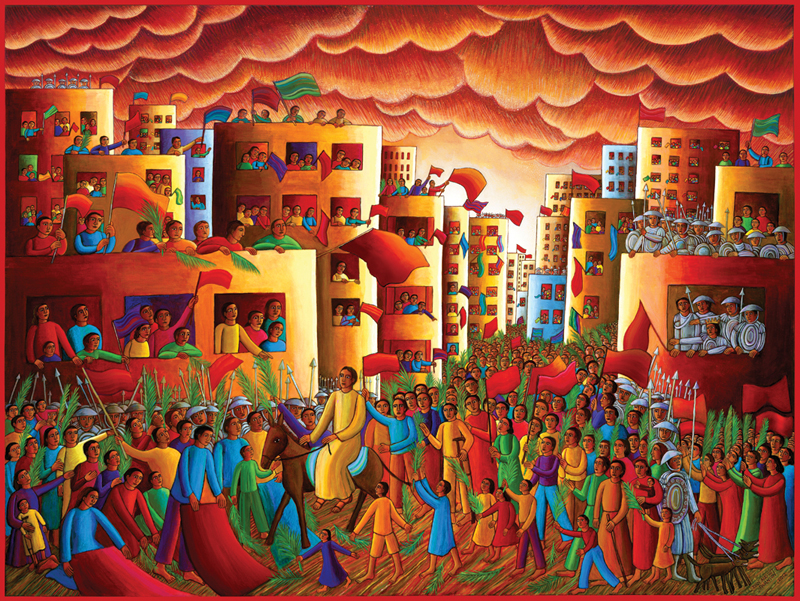
So when Jesus rides into Jerusalem on a donkey, he fully, freely puts himself in harm’s way. He knows the danger to his life, and he chooses to embrace it.
He is one of us all the way down into death, and when he hangs on the cross experiencing the total absence of God, we learn the mystery of God’s inescapable presence.
There is nowhere that God is not – even death is full of God.
However you have been accustomed to understand the events of Holy Week, I invite you today to make a little room in your tea cup for something new to be poured in.
Make a little room, perhaps for a different metaphor to speak to your life, or for seeing sin differently, or for looking more fully at death, and fear, and all the foretastes and deputies of death like shame, humiliation, illness, isolation, rejection, and the reducing of all your abilities.
The cross lies ahead, and we journey towards it in this coming week, and yet we also know – the cross is not the last word.
The resurrection is a work of atonement, and Pentecost, and the work of atonement is unfolding in your very life, in your very being, in this very moment as you follow Christ.
May you find a little extra room in your cup – perhaps by tipping out the current contents and taking another look at them by letting a fresh perspective flow in.

