

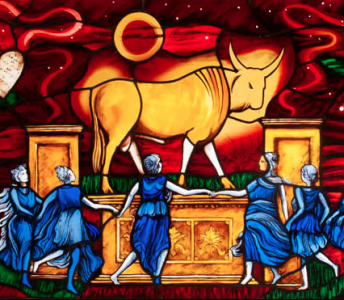
The reflection was in two parts this Sunday – the first part followed the reading from Exodus tells the story of the golden calf from the image above – and the second part followed the reading from Philippians. You can find all the lectionary readings here.
Exodus 32:1-14
This week as I continued to reflect on my experience at General Assembly, and as I prepared my report for our AGM, the thing that stood out to me in the readings was the difference in the leadership of Moses and Aaron.
At the beginning of this reading, Moses goes up the mountain to listen to God. If you are like me, and you have trouble remembering the finer details of this story, here’s a quick recap of what’s just happened: three months or so after their miraculous and narrow escape from slavery, God gives the ten commandments from the mountain top, in the hearing of all the people.
There’s smoke and thunder and lightning, and the people are all a-tremble, so they tell Moses that they want him to be the one who stands in front of God and he can pass on to them what God has said. All well and good. Moses goes off and is given a range of instructions and laws which touch on things from proper worship to rights, property, restitution and retribution.
Then Moses relays all this to the people, and they agree to everything. They make sacrifices to God and the blood of the covenant is splashed on them, and Moses, Aaron, and 70 elders all approach the holy mountain, see God, and eat and drink in God’s presence.
It’s after this that Moses is summoned up the mountain to receive the tablets of stone. He tells Aaron and the elders, ‘wait here. Aaron is in charge if there are any problems.’ And then Moses disappears into the cloud covered mountain, into the glory of the Lord which looked like a devouring fire. He’s gone for 40 days and 40 nights. The people are down below, and they have no idea what is happening. Moses could well be dead.
They begin to get restless and anxious. This is normal when we don’t know what’s going on, isn’t it? It’s normal. It doesn’t matter what happened just before. It doesn’t matter what you’ve seen or heard or what you believe.
It’s totally normal and understandable that when we don’t know what is happening, when we are waiting in uncertainty, when we think that something should be happening and it’s not – we get anxious. And like the worst kind of virus, fear and anxiety are contagious. Very contagious.
So when one person moves up the gears from restless to jittery, from worried to stressed into full blown panic…it spreads. Everyone around you starts to feel edgy and apprehensive. And when we are anxious, we make poor choices. We make poor choices because the noise in our head is all fear, and we can’t hear past the fear.
We make poor choices because fear shuts down a whole bunch of options that are still open to us – we just can’t see them. We can’t think creatively. We are in self-preservation survival mode.
You have for sure experienced this somewhere at some time in your life – because it’s normal.
So the people of Israel, in their fear and anxiety turn to Aaron, who is in charge, and tell him that they need a visible sign of God in their midst right now, and they need to do the things that make gods happy. They NEEEED it.
Again, this is normal.
People still do it now – not so much with the smelting gold in the back garden – but people bargain with God all the time. People in doctor’s waiting rooms, people in bomb shelters, people in refugee camps… all kinds of people in all kinds of situations promise all kinds of things to God in exchange for more life, for someone else’s life, for respite from suffering, for freedom. And Aaron is in the same boat with them. He’s been put in charge and he’s just as anxious and fearful as the people who turn to him for leadership.
I feel some deep compassion for Aaron right now! It is hard to be calm, clear and kind when it feels like the house is on fire. It’s not normal to be calm then. It’s normal to panic and to reach for the things that have made sense in the past, or the thing that seems like the only option left.
It takes deep trust; deep, compassionate presence to feel the fear rise, to hear the inner roar of anxious thoughts and to greet all that with empathy and then consciously turn the volume down on the fear.
This kind of trusting calm presence doesn’t come from just reading scripture. It doesn’t come from having a particular or special kind of spiritual experience. It is not an idea for you to understand. It’s a practice – an every day practice.
I find breathing slowly, evenly and deeply into my belly really helpful at such times. I find exhaling and telling my shoulders, jaw and forehead to drop, soften and melt really helpful. Once I’ve breathed myself back from the edge of panic, then I am calm enough to begin a listening practice.
I do need to listen to the fear, yes, because it’s telling me something important, and I also need to listen to the God who is peace. I practice listening with ears and with whole body, whole being. This way I learn to listen and engage with God and with life as Moses does, as God invites us all to do.
In their conversation there is back and forth. Leave me alone says God…., yes but wait, Moses says… I’m going to put an end to this nonsense, says God…please consider…says Moses. All right then, says God.
Trust is based in mutual receptivity. Moses listens to God and God listens to Moses.
Right now you may be thinking, ok, but I am not a leader. So, just remember that fear and anxiety are contagious. Each one of you, in all of your relationships can lead that movement toward anxious restlessness without standing up here and preaching about it. You can do it with just a few words at morning tea, or in the car park, but also, you can do it without even saying a word – just by the way you hold yourself, by the way you are present.
So, let’s pause for a moment, and reflect in quiet. What are the thoughts and movements within that you are listening to and making present here?
Philippians 4:4-8
These words from Paul are a balm to the anxious mind and fearful heart. Joy and peace both pass our understanding. They do not make sense – but they are not ways to trick you out of your experience by saying it’s not that bad, or others have it worse. Joy and peace reflect the practice of deep trust in God’s compassionate presence in the midst of whatever suffering, whatever destabilising, panic inducing reality you are living in.
Joy and peace might seem like advanced level spiritual fruits, slow growing, like patience. But the beginning level of practice looks exactly the same as the mature level. All that’s different is that the more you practice, the quicker you get at noticing when you are spiralling into fear yourself, and the better you get at spotting when you are joining someone else’s fear spinning out. And, you also find yourself more able to breathe yourself steady, calm and kind in the midst of whirling circumstances.
You’ll find that the more you practice reaching for and resting in the peace of trusting Christ, the more deeply that peace is anchored within you.
Practicing gratitude draws us into joy – more on that next week. Practicing surrender is what draws us into peace.
Surrender has been understood as giving up, as having no backbone or not standing for anything – giving in. But this is a fighter’s perspective on surrender. So I invite you to contemplate Christ who models for us what it means to surrender.
Christ, who did not grasp at equality with God but emptied himself in total surrender to the limitations of human life.
Christ, who did not meet the power of the Roman Empire on its own terms, who refused to use violent force to establish his kingdom, and who forbade his followers to use violence in his name.
Christ, who surrendered himself to the power of death in complete trust. Just like us, Jesus did not know what lay on the other side of death. Just like us, Jesus moved into situations of fear and uncertainty and had to choose – choose peace, choose trust, choose to acknowledge and accept this present reality.
And then, in this surrender of his own push or pull reaction, he is free – free to tap into the deeper reality of God’s love and presence which is constant and sure.
Surrender releases us into the loving arms of God and in that security there is peace that passes understanding. A practice of surrender begins with acceptance of the present, however unpleasant or uncertain. Yes, to all that is. Yes, hello. I see you, present reality, and I receive you.
This can be challenging, because the uncomfortable experience doesn’t stop being uncomfortable just because you have acknowledged and accepted it.
In the Exodus story, the people wait for Moses, unsure if he is alive. They don’t really know or trust the God who has liberated them. They still want to lean into the familiar things that made sense to them before the Passover events. They still want Aaron to fill this anxious gap, to give them what they want.
Our story, our circumstances are equally uncertain.
We may be tempted to reach back for things we’ve done in the past, or struggle to think creatively beyond the options we see in front of us. But Jesus shows us that accepting the reality of the situation – even if that reality is full of anguish – returns you to relationship with the God who is in all things.
So to practice peace this week, begin with breath. When you notice yourself feeling anxious or angry, fearful or restless: breathe slow, steady, deep. Exhale: drop, soften melt.
I know it doesn’t sound like a spiritual practice. But please – trust me on this one.

