

The readings for this sermon can be found here.
These two passages side by side in the lectionary readings is not an accident. The giving of the law in the form of the Ten commandments is set beside this vineyard parable to highlight one particular reading of the parable. That’s kind of misleading though. Parables are wisdom teaching tools intended to be multi layered and slightly obscure.
A parable is a teaching story that offers us ongoing insight precisely because it is open to many interpretations. So giving us another text to interpret the parable with limits the scope of what we are likely to hear and give our attention to.
And the reality is that both of these passages have their own context, and when we lift them out and give them a stand alone – or indeed a stand together- value and meaning we are at best courting trouble and at worst we are messing with how the Bible actually works.
So let us just consider the Ten commandments to start with.
This list of rules has been lifted out of their ancient near Eastern context and given universal status. They have been put into courtrooms, used as the basis for entire legal systems and held up as standards for every society, every culture, every person, in every age. But they are not that. They are not a set of universal rules, but a way of living that is Israel’s response and commitment to faithfulness as partners in God’s covenant with them.
I’m going to say it again, because it’s probably a bit shocking: The ten commandments are not rules for everyone to follow as a way of living a good and God-sanctioned life. Consider for a moment that it is possible for you to follow all of these rules and never love your neighbour, never be a friend, never serve or share, never work for peace or justice, or walk humbly anywhere.
So when we look to these rules as guidelines for a good life, we may be missing the point rather….which is exactly what Jesus said to the rich young man who didn’t want to sell his goods and give to the poor. However, taking them with their context and seeing what they may say to us today still offers us a lot of food for thought.
To start with, God declares I am the one who sets you free and you shall have no other gods before me. God begins with a statement of essence and relationship. I am liberating in nature and action, and I want your undivided devotion.
I wonder what you make of this… The people had just experienced a thoroughly convincing demonstration of God’s power, provision and presence. The Egyptian army and gods were totally beaten, no other gods had even come close….so why the reminder about being set free and the exclusivity clause? And why make this the number one command?
Let’s be curious here. From your experience of God in your own life, what’s the number one thing you’d say about who God is? Chances are between us we’ll have a few different responses to that question, which means if I asked, who do we think God is, we might not have a tidy answer…. so….this commandment might prompt the question: Do we worship the true God? Do you? How do you know?
Is the God you worship the one who sets you free? The one who meets you where you are, and draws you to move more fully into life? I think it can be easy to slip into believing in and worshipping a god who takes care of us because we’re special. To worship a god who comforts us but rarely challenges. It’s even oddly easy to find that we worship a god who requires we keep a set of rules and standards, even though those rules mean we aren’t truly set free from anything.
That first commandment invites us to an ‘image of God reality check’ that flows into the second commandment. We make idols out of so many things that the second commandment is one that we might want to keep firmly in its ancient context. None of us has a shrine to a local deity in our houses where we bow down in worship…but consider just for a moment your image of God.
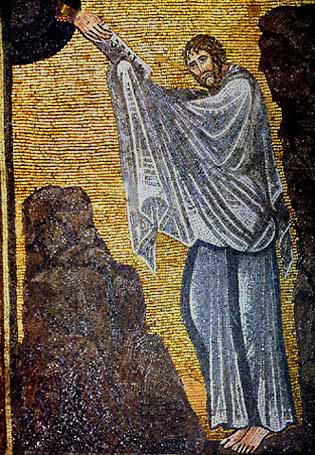
Is it male? Is it white – see the hand that holds those tablets in the image above? Is it essentially able bodied? Is it strong/powerful/privileged? Kingly? Judgey?
While these are some of the images the bible offers us for God, (well, not the whiteness) all of them are partial at best, and at worst they are images that misrepresent and distort the God who is Mystery beyond our imagining and yet is the one who liberates and loves us.
Let’s move on to taking the Lord’s name in vain. This is not about swearing – or at least, if we’re just looking at that we have missed the point again. This commandment in our context tells us that any way that we use the Christian faith as a justification for superiority is a misunderstanding of God’s choice to be in our midst. Any time we leap to God’s defence against some insult or injury to God’s dignity is a misunderstanding of God’s loving nature. Any time we hurt others in God’s name, or for the purity of the faith is a misunderstanding of God’s grace – and this is taking the name in vain.
On to the sabbath. A day of rest. A day for restoration through things that nurture the whole person that you are. That might mean a day of gardening, cooking, gathering with close friends and sharing life. It might mean a quiet day with a book or crafting or a walk in the bush and it might mean meeting with friends at church to sing, pray, listen and talk.
Sabbath is a way of remembering that you are free. You are not a slave to life’s demands. Neither are you slaves to the demands of religion! Sabbath is a time to practice letting go of efforting and enjoy the ride. And again, just like with every spiritual practice it’s not meant to be a simple set aside a day to do this. Sabbath isn’t another box to tick – it’s the opposite of that.
Sabbath is a day to practice being. For most of us, being gets lost when we start doing, so taking a day set aside to practice being is so helpful. When we take time out to give our attention to what is, we are often surprised:
Oh, this is how tired I am. This is how lonely I am. This is how scattered, how frustrated, how busy, how anxious. This is how much energy I put into trying to make things happen the way I want. This is how hard I try to be good enough, to fit in, to belong. This is how much I focus on looking after everyone else.
The next six rules all seem pretty straightforward, except I suspect that the last commandment could use some extra scrutiny.
When I read anything from the Hebrew scriptures, I have to remember that these laws were written for a very different period in time and a very different culture. They were written when wives, houses, donkeys, oxen and other humans were all belongings and no one was going to argue about it. Back then. Now – we have to do some careful checking in.
Is it ok to own slaves? No, we have globally agreed now that it is not. Is a wife a belonging? Well, in the western world we are mostly agreed on this one. But not all of us. That is still a thing women and girls are living with and if it doesn’t give you pause when you read this commandment and feel the burden of it, then I can guarantee the rest of the commandment hasn’t properly landed.
Because alongside questions of equality sits the reality that our whole economic machinery is fuelled by covetousness.
Advertising and marketing campaigns rely on stimulating covetousness to promote products that you don’t need that will not transform you into the happy and successful person they promise. Coveting is comparing what I have with what you have and feeling dissatisfied. Coveting is competing with others to be more by having more. Coveting is hustling for worthiness and value. It’s utterly exhausting and demoralising because no matter what you have someone else has something better. The promise of fulfilment and satisfaction and peace is empty.
And the antidote for number 10 is number 1 and number 4. Undivided devotion to the liberating God and Sabbath. Take a sabbath rest and be with the God who rescues you, who sets you free, who wants to be with you.
If we want to be the people who God gives the vineyard to – if that’s what Jesus is meaning by his parable – then we might do well to look at how the ten commandments might shape our response to God’s new covenant with us. How are we living our commitment of faithfulness to God?
And is it leading us to love of neighbour, to be a good friend, to share, serve, make peace, work for justice and walk everywhere with humility?
Are not these the fruits of the kingdom?

