
You can find all the readings for Sunday here.
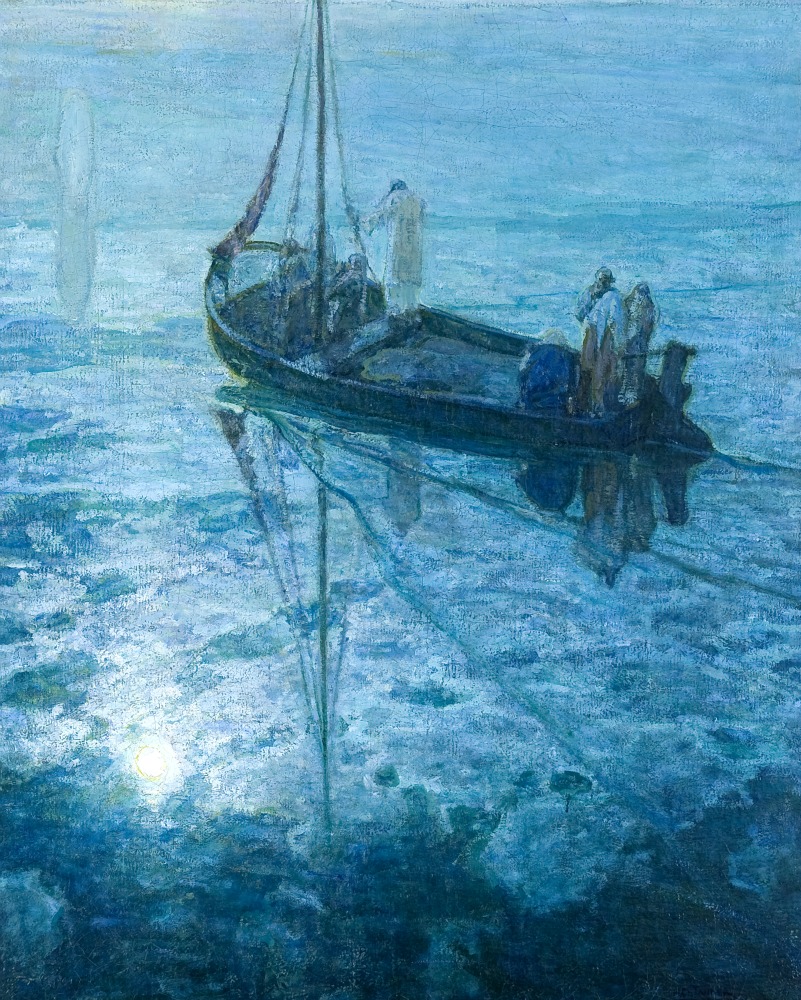
Immediately he made the disciples get into the boat and go on ahead to the other side, while he dismissed the crowds. And after he had dismissed the crowds, he went up the mountain by himself to pray. When evening came, he was there alone, but by this time the boat, battered by the waves, was far from the land, for the wind was against them. And early in the morning he came walking toward them on the sea. But when the disciples saw him walking on the sea, they were terrified, saying, “It is a ghost!” And they cried out in fear. But immediately Jesus spoke to them and said, “Take heart, it is I; do not be afraid.” Peter answered him, “Lord, if it is you, command me to come to you on the water.” He said, “Come.” So Peter got out of the boat, started walking on the water, and came toward Jesus. But when he noticed the strong wind, he became frightened, and beginning to sink, he cried out, “Lord, save me!” Jesus immediately reached out his hand and caught him, saying to him, “You of little faith, why did you doubt?” When they got into the boat, the wind ceased. And those in the boat worshiped him, saying, “Truly you are the Son of God.”
Matthew 14:22-23
This is a reflection on the gospel reading.
When I was young, my dad told me stories. He made up bedtime stories for our entertainment and he also told stories in an attempt to educate. I say an attempt, because although my parents tried hard with me, I never really believed the educational stories any more than I believed the ones about the teddies who went on adventures and got into scrapes. One of the educational stories my dad told stayed with me because of it’s obvious unbelievability…. I’ll tell it to you and you can hear for yourself….
Once upon a time, there was a young girl who was out in town with her family. It was a busy Saturday morning, and they were walking down a noisy street with lots of other people out and about – talking to each other, calling out hellos while cars and trucks rumbled up and down the street. Then, something happened – I can’t remember what it was…perhaps the young girl spotted her best friend from school across the road, or maybe she dropped something precious she was carrying that rolled into the road…in any case, for some reason she carelessly ran out into the traffic.
By some miracle she wasn’t immediately run over, BUT two trucks were converging on her from each side! She could not safely cross back to her family or continue over to the other side. Fortunately, her father assessed the situation in a moment and at the top of his lungs he yelled, “STOP”.
And the obedient child immediately froze in her tracks perfectly in the centre of the road. The two trucks passed by behind her and in front, missing her by inches. And that’s why it’s important to do what you are told straight away. The end. See what I mean?
Now, I thought it was an utterly unbelievable story until I heard Annie tell a story of Miles teaching her to drive. You remember what it’s like when you are a learner driver, and you are on hyper alert, just a hair below full on panic. And if you have ever sat with a learner driver, you know what it’s like to put yourself in the hands of someone who is not yet skilled enough to do it but is nonetheless travelling at speeds that could cause significant injury.
It’s stressful for everyone.
Annie told me how, as she drove down a two lane highway, Miles barked at her to turn in behind that red car, and she obeyed immediately, without mirror, signal manoeuvre – not waiting for the gap in traffic…and crashed into the car beside her on the road. So, obviously, I was wrong and there are people in the world who obey without question, straightaway. Or perhaps there are people in the world whose commands feel powerful enough to create compliance?
I’ve been thinking about this because of the gospel story this week.
It follows on directly from last week’s story of the multiplied bread and fish, and in it we see that Jesus hadn’t given up on his need for time alone, he had just deferred it. He finally dismissed the crowds and also the disciples, sending them off in the boat while he takes time to pray. We know this story, it’s one I personally love. I think the idea of walking on water is delightful, and captivates the imagination… I mean, who hasn’t tried it?
It seems perfectly understandable to me that Peter would want to give it a go…why wouldn’t he? What’s the worst that can happen? We know Peter can swim, because he does in John’s gospel. But we also know that the sea of Galilee can whip up a storm that terrifies even experienced fishermen.
Matthew recounts that story in chapter 8, when the boat is in danger of sinking and the disciples have to wake Jesus up and beg him to save them. When he does, he first asks them where is your faith? And then he stills the storm by his command. The disciples then turn to each other and ask, I expect quietly, who is this?? Who can command the wind and the waves?
They know the answer, by the way, but they still have to ask the question.
And now, here they are again, in a boat, in rough seas.
In the past, when I’ve considered Peter’s request to walk on the water to Jesus, I’ve thought of it as going from the safety of the boat to the risky uncertainty – impossibility – of the water. I thought of the boat as the safe place to be, but actually, I don’t think that’s how it would have seemed to those in the boat. The sea, in Judean imagination, was a symbol of chaos and danger. Being on the sea was never ‘safe’, no matter what vessel you were in.
It’s helpful for me to recognise that because Peter frames his request using rather strange language. Have you ever considered that? If it is you…command me to come to you. Doesn’t that sound a bit odd? I thought so, anyway.
Until I came across an essay by rabbi Jonathan Sacks, who was exploring the spirituality of listening. The most important word in Judaism, he says, is ‘Shema’, which is usually translated ‘‘hear’’ as in ‘hear, O Israel, the Lord our God, the Lord is One’. But rabbi Sacks said that the word shema is almost untranslatable into English because it has so many different meanings. It does mean hear, and also listen, and pay attention, and understand, and internalise, and respond and obey.
The Hebrew scriptures say again and again: listen, heed, pay attention. Hear what I am saying. Hear what God is saying. Listen to what God wants from us and for us. If you would only listen … Judaism, says rabbi Sacks, is a religion of listening. In listening, you understand. In hearing, you respond. Listening to God speak is how God is made known.
This is very different from our Western approach to knowing.
Our knowing is much more focussed on seeing. We take a perspective. We make observations and we like illustrations. We speak of insights or foresight and hindsight. We engage in introspection and when we understand something we say, ‘I see’. This allows us to take a spectator seat to our knowing. We aim to be a little apart, separate from what we observe.
Not so in Judaism. Because God cannot be seen, and no images of God can be made. Instead, God communicates in sounds. God calls, speaks and commands, and the people listen and respond. We speak to God in our prayer, and in the speaking and the listening there is connection and engagement – there is revelation and there is relationship. In the Hebrew sense, knowing is closeness and intimacy – knowing means involvement.
So, if it is you…says Peter.
I hear you, Jesus. I hear you and if it is indeed you, then I need to do something in response. So command me, and I will obey. Of course.
He’s not stepping out of a safe place into a dangerous one. In the boat/on the water…It’s all dangerous. But he is stepping deeper into the recognition of who Jesus is and what it means to know him. And when he starts to sink and panic, just like in the storm tossed boat before, Jesus asks about his faith. Why did you doubt? I think it’s not so much a rebuke though.
I think it’s much gentler than that… more like when your child is ready to take off the stabilisers on their bike and they go a good distance before they wobble and over correct and fall off.
I think there’s a soft chuckle in his voice when he says why did you doubt? because Jesus reaches for him straight away, and when they are back in the boat, no one is asking Who is this??
No, they worship him, because they know. And we know.
So listen. Are you being called to step deeper, too?
What are you being called to do? And how will you respond to that calling?