

Candle lighting
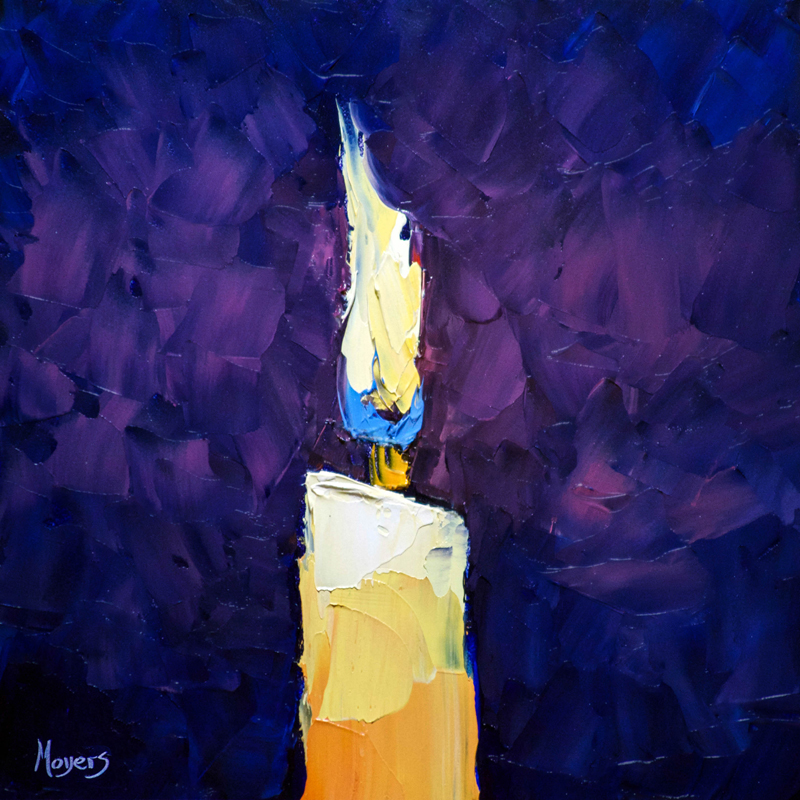
For gathering today in this sacred space, We light the flame.
To sing hymns of praise and adoration to our God, We light the flame
For sharing together in the mystery of holy communion, We light the flame
And to honour the presence of Christ in all: We light the flame.
Call to worship
The God of rainbow and covenant, the God of Wilderness experiences,
The God of dark nights of the soul, the God of abundant love and gracious calling
Journeys with us throughout Lent; to guide and guard us in moments of temptation and trust;
In fear and in faith; in sadness and joy, grief and healing.
Therefore let us bless our God, rejoice in Christ’s presence and seek the strength of the Holy Spirit – and let us worship God.
A Pause to Gather Ourselves in Silence
A moment to pause; to gather yourself from all the places you have already been scattered this day; to breathe slowly and deeply as you enter fully into this present moment.
The ministry of music
“All the earth is a living icon of the face of God” In these words, which inspired Malcolm Gordon’s song, St. John of Damascus reminds us that every place is sacred, full of God’s presence and glory – the glory that shows itself in light and in darkness, in beauty and in brokenness because it is the glory of love that ‘ bears all things, believes all things, hopes all things, endures all things’. (1 Corinthians 13:7)
The Gospel reading

By Bernardino Mei – 8gGjtgJKKO7AGQ at Google Cultural Institute maximum zoom level, Public Domain, https://commons.wikimedia.org/w/index.php?curid=22177903
The Passover of the Jews was near, and Jesus went up to Jerusalem. In the temple he found people selling cattle, sheep, and doves, and the money changers seated at their tables.
Making a whip of cords, he drove all of them out of the temple, both the sheep and the cattle. He also poured out the coins of the money changers and overturned their tables.
He told those who were selling the doves, “Take these things out of here! Stop making my Father’s house a marketplace!” His disciples remembered that it was written, “Zeal for your house will consume me. The Jews then said to him, “What sign can you show us for doing this?” Jesus answered them, “Destroy this temple, and in three days I will raise it up.” The Jews then said, “This temple has been under construction for forty-six years, and will you raise it up in three days?”
But he was speaking of the temple of his body. After he was raised from the dead, his disciples remembered that he had said this; and they believed the scripture and the word that Jesus had spoken.

Some thoughts for reflection
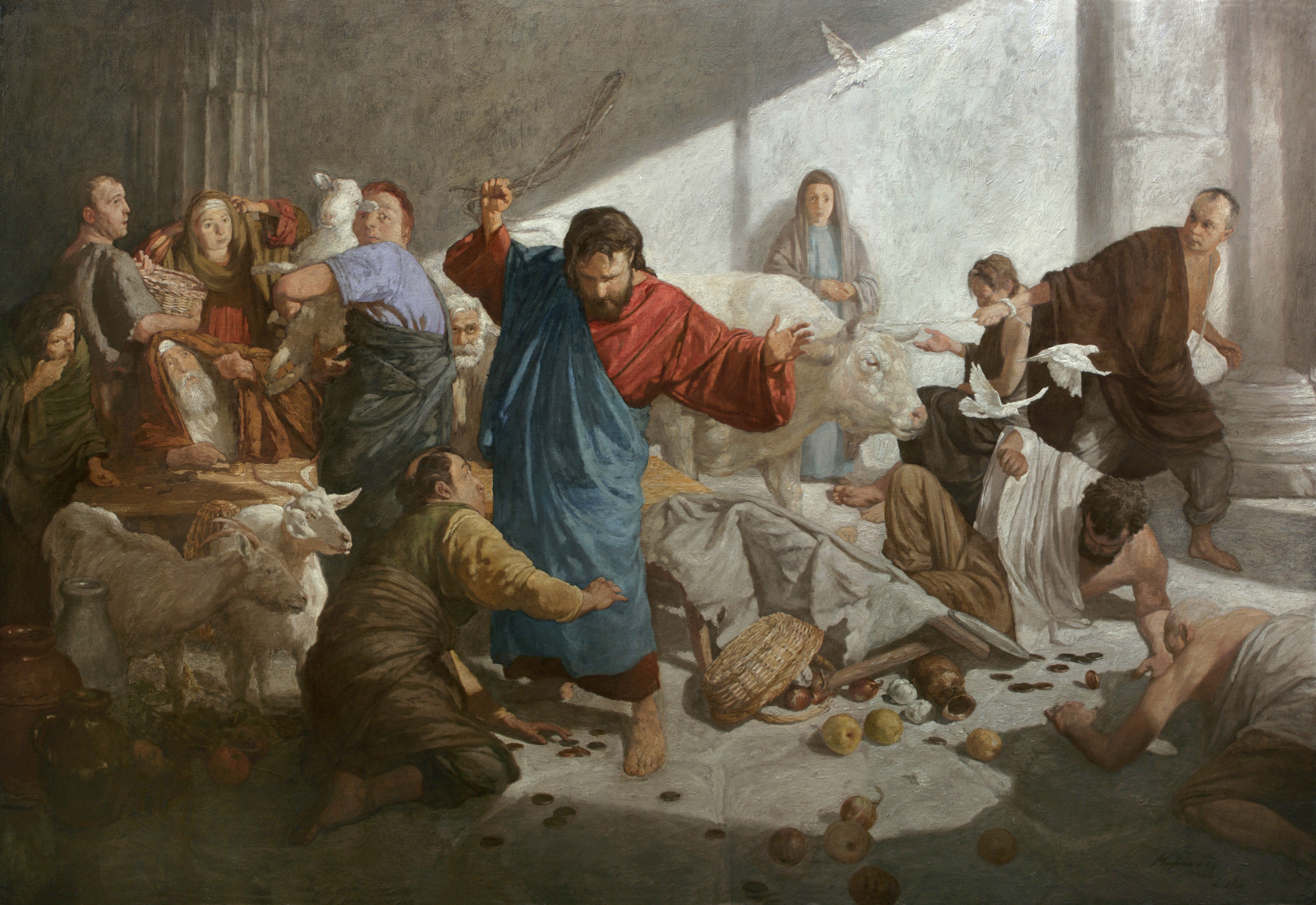
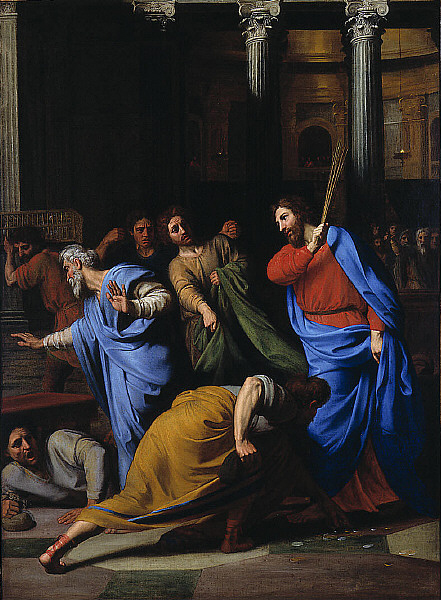
In almost all the images I could find for this story Jesus is shown with a fierce looking whip and a fierce expression on his face. He is obviously threatening violence to men and women and scaring the children. People are falling left, right and centre, and there is horror and outrage. But when I read this text carefully, I notice it says that on seeing the marketplace in the Gentiles court of prayer, Jesus made a whip of cords (bits of rope lying around?) and drove out the sheep and the cattle. He tipped over tables and spilled the money. He didn’t throw cages of doves about, and there’s no mention of people being attacked.
I wonder, then, why do we imagine it like this? Why are we so quick to assign to our God the violence we humans seem to have no trouble inflicting on each other? I have heard this story used in the arguments for a ‘just war’ theory, as if this is a precedent set by Jesus: when the offence is against a sacred value then violent defence is allowable. This angry and violent perception of Jesus has been used to justify our own angry and violent thoughts, words and actions.
The story is open to our interpretation – do we see what we expect to see? Do we see what we want to see? Is there a way to see that Jesus is making an energetic, bold and dramatic statement that is provocative but not violent? What difference does it make?
The season of Lent offers us many opportunities to be aware of and explore more deeply some of the big themes of Easter. This year with the pandemic still gripping our world we might hear this story in a different light, with more awareness of the importance we give to the places where we gather for worship, what that place means to us and how we behave in it.
Gathering freely has become a privilege, something that can be and has been taken away from us on occasion, but for so many around the world, this has been taken away for a long, long time. We are more keenly aware of the value of togetherness – in its many forms.
When we are able to gather freely and routinely each week, then our buildings often become connected with a sense of community identity. They, as much as we who gather within them, become invested with significance because of time, energy and financial efforts put into them. They become a focus for our attention and activity. Occasionally being kept out of them and away from each other over the last year has pushed us to shift our focus and given us the opportunity to see things from a different perspective. I wonder what that has been like for you?
On another level, the cleansing of the temple also invites us to consider the space we keep within.
Having just returned from ten days away in the quiet and beauty of Queen Charlotte sounds, I am very conscious of how easy it was to slip into rest and relaxation there, away from the routine and habits of ‘normal’.
Of course, it’s not impossible to find ways to restore my energy and nourish my soul here at home, it just takes more planning and a certain amount of determination to stop. To ignore my phone. To turn off the TV and to tune out of the dramas playing out around me or in my head. To put down the To Do list that never, ever gets any shorter. To choose non-doing, to see and enjoy and keep a space, an inner temple, clear and quiet and prayerful.
So perhaps you might like to spend some time this week considering the inner temple of your own heart.
What may need to be cleansed within that space? What excuses, denials, opinions and expectations, what self-satisfied complacency, what rattling anxieties, what misplaced zeal, what idolatry are trading their wares in your inner sanctuary ?
What are the obstacles to your opening to the divine presence who already dwells within you?
How might your inner temple be a house of love and acceptance rather than a shelter for fear and bitterness? What spiritual practices might support you in a purge?
Questions for conversation
What is your earliest memory of experiencing a sense of the sacred/ divine presence?
Where do you see the longing for sacred space being expressed or explored in our culture today?
Communion
Prayers of the people
It is with a sense of deep gratitude, eternal God,
that we come together in the sacred space of our hearts and homes.
We take a moment to pause in your presence
recognising our desire to offer our thankfulness and praise to you,
to bring our longings and hopes into the light of your presence.
In silence and stillness, rest in the inner temple of the soul.
As thoughts, emotions and sensations arise and ask for your attention, simply and softly let them go…there is no need to follow or engage….the divine presence asks you only to rest in love. There is no need for words, explanations or requests.
All is known. All is held. All shall be well.
Prayer of the day
At the beginning of time and at the end
you are God and we bless you.
At our birth and in our dying, in the opening of the day and at its close, in our waking and in our sleeping
you are God and we bless you.
You are the first and the last, the giver of every gift, the present without whom there would be no present, the life without whom there would be no life.
Lead us to the heart of life’s treasure that we may be bearers of the gift.
Lead us to the heart of the present that we may be sharers of your eternal present.
Amen.
Celtic prayer from John Philip Newell, adapted.
Blessing
As we go forth into the sacred mystery of everyday life, may we move with the flow of grace and be carried along your way by the energy of mercy and compassion.
May we recognise, hidden in our routines and our relationships, your many invitations to follow you on the way, and to learn from you how to walk this pilgrim’s path.
May we daily glimpse the underlying reality of Love that is stronger than death and live in the way, the truth and the light of this hope.
Amen



On Thu, Mar 4, 2021, 9:54 AM Saint Peters Presbyterian Church wrote:
> Admin posted: ” By Giotto di Bondone – Unknown source, Public Domain, > https://commons.wikimedia.org/w/index.php?curid=94625 Candle lighting For > gathering today in this sacred space, We light the flame. To sing hymns of > praise and adoration to our God, We li” >