
Candle Lighting
The spirit of imagination is a gift to all people.
The spirit of faithfulness is the gift of the earth.
The spirit of hope breathes in the hearts of all people.
The spirit of freedom was announced by those
who went before us and we proclaim it again today.
The spirit of love is a gift to the church in every age.
We light the flame in the name of the Spirit of God.
The Pentecost candle is lit.
The spirit is dancing, moving, struggling, rising
and calling to the ends of the earth.
We have seen the flame of the spirit in our midst.
Thanks be to God.
(D McRae- adapted)
Opening Prayer
Spirit of God, breathe into our being; breathe into our doing.
Spirit of God, hover over our chaos; hover over our calling.
Spirit of God, burn brightly in the darkness of our fear; burn brightly through our lives.
Spirit of God, comfort our hearts and our world with peace that passes our understanding and sustains us in uncertainty.
Spirit of God, guide us on our journey together; guide us into wisdom and grace.
Amen.
A Song for the Spirit
There are many songs that speak of the power of the Spirit and that invite God to work this power in us and through us. Here are a couple of options for you to enjoy (or skip over if they’re not your cup of tea).
Holy Spirit, Come to Us – Taize
Breathe on me, breath of God – hymn sung by an enthusiastic congregation and with brass band accompaniment!

The Gospel Reading
Reflection
The audio clip is above, and the full text below.
Scroll down to the next image for questions to reflect on.
The two readings from the lectionary selections today offer us an interesting frame for the story of the extraordinary experience on the day of Pentecost.
I’m going to start with the gospel reading, which we also heard the Sunday after Easter, because this is the beginning of the story of Thomas who missed out on the first appearance of Jesus inside the locked room. So this story is from Easter Sunday morning, and it returns us to the reality the disciples were facing before they began to understand, well, anything, really. They had journeyed with Jesus, learned from him, listened to him and practiced doing what he did – more or less – and yet when his journey started to go in a direction that made no sense to them, a disastrous direction, they abandoned him – more or less. After his execution they gathered together in a safe room, waiting for the other shoe to drop; waiting for the sound of soldiers marching towards their hiding place and the urgent knock on the door. This is where they are – shut up in a room with a story that terrifies them – and Jesus appears, tells them Peace! And breathes the Holy Spirit into them, nice and gentle.
I guess you could hear a bit of a rebuke in Jesus’ greeting, if you thought that the disciples ought to have been braver, ought to have been out there carrying on Jesus’ ministry and willing to suffer like him. They did say, after all, that they’d follow him anywhere and that they’d die for him and with him. But I don’t hear rebuke in these words, and this breath of peace. The disciples will die for their faith in Jesus. Just not yet. First, they have a mission, and this story is the point where Jesus commissions them and sends them out. He tells them: Peace; receive the Spirit and now you are being sent out just as I was sent. This story is the first of Jesus’ resurrection appearances to the male disciples.
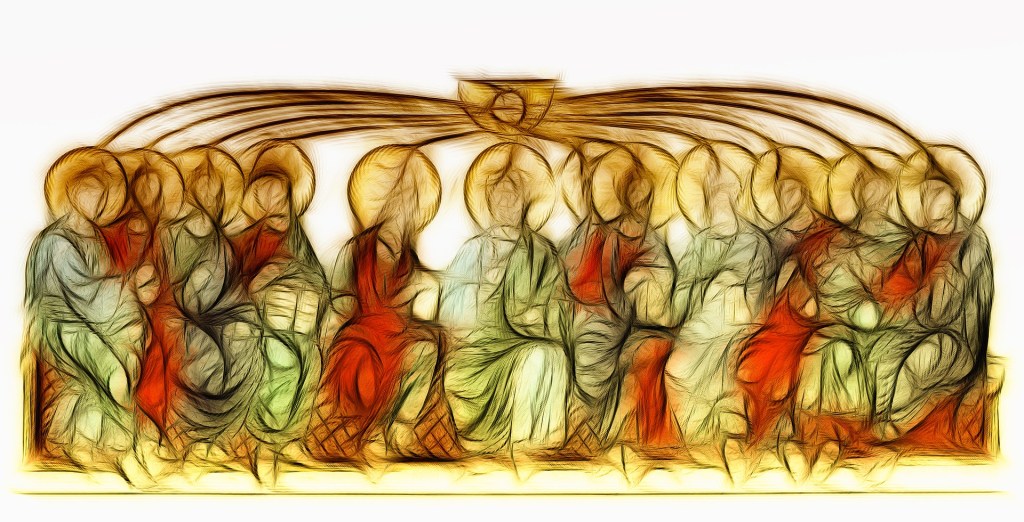
The story from Acts happens seven weeks later, after the ascension, when Jesus the Christ has let go of the limitations of his embodied, physical form and returned to the fullness of Being – which is mystery to us who can see only a dim reflection and must still wait for the full revelation of face to face. The story from the book of Acts tells a very different experience of the disciples receiving the Holy Spirit. It is full of sensory excitement with fiery lights and sounds and the overflow of joy as the disciples tell of God’s glory in every language of home. It is this outpouring of joyful witness that draws a crowd of interested and curious people. What is happening in that house? How can we be hearing what we are hearing and what does it mean? The joyful witness also provokes a small group of scoffers, but Peter, with the 11, puts them right with no signs of fear or hint of a desire to be safe behind closed doors.
I don’t know about you, but I’ve heard a number of sermons about this day and this story, what it means and the lessons we ought to learn from it. In the church we attended in the states, we used to celebrate this day as the birthday of The Church, and in other churches we made this day about an opportunity for charismatic renewal, a fresh outpouring of the Spirit with an expectation that we might experience again in our gathering some of the extraordinary gifts of the Spirit. In many ways, whenever I hear the story, I already hear the explanation and teaching I know from before. Perhaps you do, too.
So let me highlight just a few aspects of this story that I’ve noticed we, the church, have emphasised and interpreted and used to support a particular way of understanding both mission and discipleship.
Firstly, the wildly dramatic aspect of this story has had a lot of attention in the last 30 years or so. Here we find an undeniable demonstration of God’s presence and power as the tongues of fire set the disciples alight with praise. Not only this, but the spiritual gift of tongues makes their witness to God’s glory understandable to ‘the world’ which has, quite conveniently, come to the disciples’ doorstep in Jerusalem. This loud witness is followed by the previously cautious Peter standing up and preaching with courage and conviction. Peter, who has denied even knowing Jesus, who hid in the locked room with the others, now stands up boldly and proclaims the fulfilment of prophecy and goes on to explain the scripture and convert thousands in one day. His transformation appears to be instant – at least, this is what I was given to understand. In the tradition I began in, there was the expectation that receiving the Holy Spirit should be like lighting a firework – you pray the prayer and stand back! Who knows what might happen… of course, experiencing peace was also an option but it was definitely not the experience that was sought after.
Of the two stories, the breath of peace and the tongues of fire, I know which one would market best. We humans are drawn to drama. We turn to look when a toddler kicks off in the supermarket, and we love action heroes. We slow down to check out a crash on the side of the road, or when someone starts raising their voice in public.
This day of Pentecost story taps into our desire to experience something moving and exciting.
It also taps into our desire for proof, for something clear and certain which looks like and often feels like security to us – something we can be sure of and rely on without risk.
It taps into our fear that when we talk about faith we will encounter sneering that we cannot brush off or objections we cannot disprove.
Here, the Spirit comes, the disciples praise God and the people respond with curiosity and wonder.
This story also taps into our hope that the witness to God’s love might be dramatically successful, and also quick, because people are, quite simply, convinced by hearing and seeing our proof of God’s presence and power. And we humans are drawn to power. It’s one of the ways we attempt to control our world, and to make ourselves feel safe.
So this story taps into our longing to have power to overcome our fears, to fix the things we think are broken or faulty in us, and the world, and to reward us for our efforts by surrounding us with people who come to us and agree with the way we see and interpret life.
But that hasn’t been my experience of following Christ, and I don’t believe that is what the good news of the gospel promises or invites us to.
If we look again at Peter’s story, you’ll notice that it doesn’t back up the perception that the Holy Spirit performed an instant transformational act upon him. He and the other disciples had just spent seven weeks in rehab with the risen Christ. There were nights of fishing and breakfasts on the beach. There were hard conversations and relationship issues to work through. Peter has been undergoing a slow transforming of his heart and mind, and this isn’t finished by the dramatic visitation. In the coming weeks we see Peter still learning just how wide and inclusive God’s love is as he dreams dreams and encounters God’s Spirit among those who he thought were pagan, non-believers and unclean gentiles. Peter learns the fullness of the good news from those outside the church, and he continued to be changed and challenged in his leading of the church and ongoing discipleship.
It may not be obvious to you, but this recognition of the slow process of transformation, of the ongoing learning and the growing into wholeheartedness has massive implications for how we understand discipleship.This is a process of slow growth which is often hidden from our own sight. This is about nurturing the fruit of the Spirit and the practice of partnering with the Spirit.
It also has massive implications for how we understand mission. If this is our model – preach a convincing sermon and get conversions – I believe we have utterly missed the point of the good news.
Our God isn’t counting heads or bums on seats.
Our God – Father, Son, Spirit – is Love; is wholly relational; exists as relationship and is focussed simply on being in a relationship of love with us and all creation.
I believe the mission of God is the healing and restoration of all relationships through love poured out for us in Christ. I believe that we are called to participate in that healing, restoring mission in every part of our lives – in our own hearts through the ongoing transformational presence of Christ in us through the Holy Spirit, and in our world through our unique gifting.
You may or may not agree, but even if you were in accord with that statement, you may have a very different idea of how that works and what that looks like. As we are on the cusp of returning to our place of worship, I have been thinking about and looking at what we do and why….
So, I wonder what discipleship means to you, and how you feel about that?
I wonder what mission means to you and how you feel about engaging in mission?
I wonder what do you think it might mean to be a missional community and what are the motivations and expectations around what we call ‘doing outreach’?
These are things to think carefully about and to talk over, and it is worth examining the stories that have shaped the church’s thinking and action here, because the world has changed – again!
The question is: will we also change?
Questions for conversation and reflection
What does mission mean for you? What has shaped your understanding?
What does it mean to you to be sent? What does that look like in your everyday life?
Which image of the Spirit is more appealing to you – the breath of peace from the gospel according to John or the flaming tongues of fire from the Acts story? What makes it more attractive? How do you see these two images complementing each other?
What has been your understanding of the Holy Spirit? How has that changed over time and with experience? Where do you see signs of the Spirit’s presence and action in your life now?
Prayers of the people
O God of many names, Lover of all peoples, we pray for peace in our hearts and homes, in our nations and our world.
As we pray, we listen to the need within, and we listen to the needs of our world.
There are those among us, in our family and our communities whose struggles and suffering is known to us and moves us. There are many more we do not know.
There are many who are in desperate need in our wider world – many more than we are accustomed to accept as normal. There are many who are weary and despairing, hungry and hopeless, without voice or power or protector.
It is too easy to ask you to act while we resist change and cling to our comforts.
So we ask you to draw us out and on into the flow of your grace; awaken us to the nudges of your Spirit when we pause too long; teach us how to grow and open the store houses of patience and compassion deep within our souls; show us the next step on the path as you form us and send us to become a blessing for all creation.
Keep us in the spirit of joy and simplicity and mercy.
In and through Jesus Christ our saviour,
Amen.
Blessing
Go in peace.
Love and care for one another in Christ’s name;
and may God so bless you,
that all who see you or hear you feel welcome in your presence;
may the Spirit so touch you
that others are comforted by your words and your actions,
and may Jesus the Christ dwell in you so richly
that others are drawn to God by you
Go well, go humbly, go in peace. Amen