
The reading
You can find the reading for this Sunday here, or you can listen to the audio clip below.
The Reflection… if you want to listen
…and the text if you want to read
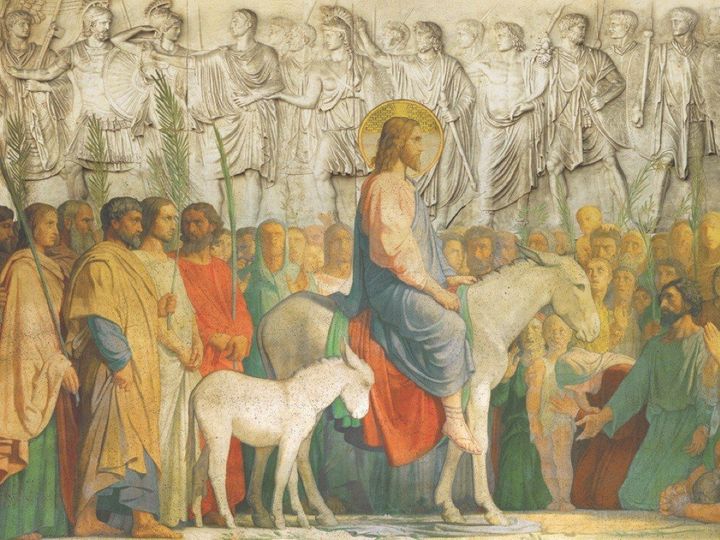
The reading for today is Matthew’s version of the story of Jesus’ entry into Jerusalem riding on a donkey. Matthew’s whole account of the gospel is peppered with references to the Hebrew Scriptures and with proofs of prophetic fulfilment, and he pops one of those in here too. In using the quote from Zechariah, Matthew establishes this entry into Jerusalem as a claim to the throne – the king comes to you riding on a donkey.
You may have heard sermons in the past where much was made of how this indicates humility, but biblical scholars are now recognising that kings rode horses when they were going to war, but in peacetime a donkey was more the norm. Which means that Jesus, in choosing the donkey, is indicating something important about the nature of the kingship he is claiming. It is peaceable.
Because we listen to this story on this Sunday each year, it is known as palm Sunday, named for the branches that were cut, waved like flags and laid on the road to honour Jesus. This story and this Sunday mark the beginning of Holy Week when we retell and remember the stories of Easter.
The entry into Jerusalem is described here like an exuberant parade, an outpouring of nationalistic hope and excitement, which was bound to cause alarm to the occupying Roman forces. And from here, having no doubt stirred up unease among the armed forces, Jesus moves quickly to the Temple where he creates mayhem by turning over tables and provoking the priests by claiming God’s house as his own.
While we know this Sunday as Palm Sunday, we know this story as the triumphal entry. As I was reflecting on it, I wondered where exactly was the triumph? Was it a triumph that on this day Jesus is recognised as the rightful king of the Jews – a Son of David who might take the throne, lead a rebellion and overthrow the Roman rule? Was it a triumph that on this day people called out ‘Hosanna!’ a cry for help, a recognition of the need for someone to save them from their oppression and their suffering?
Because in just a few days time, Jesus is totally rejected as a king. In just a few days time, Jesus is taunted and ridiculed for not even being able to save himself, never mind the rest of the people.
Where is the triumph? What victory is won? I think perhaps this story shows us God’s version of triumph.
In this story, kingship is reclaimed for God. The people of Israel had begged God to let them have a king so that they could be like the other nations, and now God takes back kingship and demonstrates how the kingdom of God, the kingdom of heaven, is very unlike the other nations. In the stories that follow through the rest of this week we will see, Jesus, humble and obedient to the self giving love of God, triumphing over death through death. Triumphing over suffering through suffering and triumphing over oppression through being persecuted.
He comes as Prince of Peace, and yet by his coming he also increases tension and he provokes a chain reaction which will lead to the cross. And he has already acknowledged and (mostly) accepted this – long before he is arrested, accused and executed. He chooses to allow himself to be poured out, to be with the aching emptiness and raw agony of dying. He chooses to say yes to suffering, to receive into himself the pain and fear fuelled cruelty, to face in to the evil intent to hurt, humiliate and eventually kill him.
This is God’s version of triumph.
On this day Jesus is recognised as the rightful king of the Jews – a Son of David who comes in peace and fights evil with nothing but love. So that nothing now can separate us from Love. Nothing.
Love chose to become human, to be with us even in the places where we are the least human we can be. Even when we are afraid for our own lives and in desperate survival mode. Even when we feel isolated and separated from one another and lose all sense of belonging and connectedness.
Even when we see threats all around us and scarcity ahead; even when we believe nothing can be trusted and despair is gnawing on our bones. Nothing separates us from Love, ever. This is the cornerstone of our faith. Which means that following in the way of Jesus we, too, can learn to being with suffering without fear. We can choose to be with tension without anxiety, and we can practice being with conflict without anger.
Over the last week of lockdown, I have heard in my neighbourhood some tensions rising. Some raised voices, some short fuses and overreactions. It’s totally understandable, of course. We may not be particularly anxious yet about contracting the virus, even if we should be concerned about that, but many of us are used to a bit more space; many of us are used to a wider set of interactions that give us a breadth to our life we are currently missing; many of us are accustomed to having our work give us purpose, structure and significance to each day, not to mention giving us a sense of security that we are earning enough to run the household.
Over the last week I’ve also heard the precautions we are taking being referred to as social distancing and then I noticed this term was changed to physical distancing.
We cannot afford social distancing. In our postmodern culture we are already isolated enough, and more than ever we are recognising the importance – the foundational importance – of being connected and being with each other. Our isolation is especially hard at the thresholds of life and death. We do not want to be alone as we bring life into the world, and we do not want to be alone as we die. We are remembering that each ‘I’ needs a ‘you’. We are remembering that every ‘we’ needs an ‘us’ – even more than ‘we’ need a ‘them’.
And so as we recover a sense of what it means to be human and to be with each other, it is good for us to reflect on the other aspect of triumph in this story – the fact that on this day people called out ‘Hosanna!’ Help us! Save us! Because it seems obvious that we would pray for God to save us now, to save all who are suffering in so many different ways from the pandemic. Save us and rescue us – take this away… keep us safe…even take us out of this – are all prayers I’ve heard expressed in various places over the last few weeks.
This story, and the Easter story both show us that the pattern of God’s action in Christ is to join us in the midst of our mess, not to lift us out of it. Matthew emphasises for us over and over that in Jesus the Christ we see God revealed as Emmanuel – God with us. God with us, sharing our pain and helping us to bear it, even when it makes no sense. We tend to forget, with the benefit of hindsight, that Jesus did not have a window into the joy of Easter morning as he set in motion the events that would lead to his death. He rode into Jerusalem and he deliberately initiated conflict. He knowingly provoked the violent reaction that led to the agony of Good Friday. In doing this he chooses to trust, he chooses to allow nothing but love to move him, to hold him, to keep him.
Love does not keep him safe, but more, Love does not let him down.
This is God’s version of triumph.
Sharing in the suffering of others is not the conventional understanding of how to win a victory, but I hope you can begin to see that as triumph. Because until you can, I’m not sure you can grasp either the meaning of the cross, or the hope of the resurrection.
The path to Life leads through death…so let us walk this way together.

